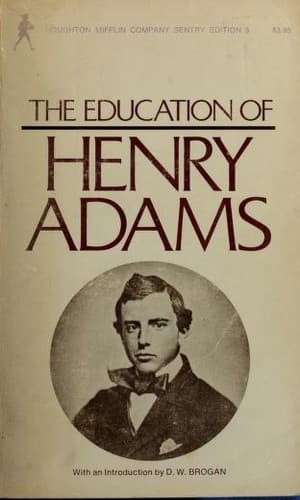
Adams, Henry, 1838-1918; Historians -- United States -- Biography
Thus far, the private secretary felt officially sure of
dishonesty. The reasons that satisfied him had not altogether satisfied
his father, and of course his father's doubts gravely shook his own
convictions, but, in practice, if only for safety, the Legation put
little or no confidence in Ministers, and there the private secretary's
diplomatic education began. The recognition of belligerency, the
management of the Declaration of Paris, the Trent Affair, all
strengthened the belief that Lord Russell had started in May, 1861,
with the assumption that the Confederacy was established; every step he
had taken proved his persistence in the same idea; he never would
consent to put obstacles in the way of recognition; and he was waiting
only for the proper moment to interpose. All these points seemed so
fixed--so self-evident--that no one in the Legation would have doubted
or even discussed them except that Lord Russell obstinately denied the
whole charge, and persisted in assuring Minister Adams of his honest
and impartial neutrality.
With the insolence of youth and zeal, Henry Adams jumped at once to the
conclusion that Earl Russell--like other statesmen--lied; and, although
the Minister thought differently, he had to act as though Russell were
false. Month by month the demonstration followed its mathematical
stages; one of the most perfect educational courses in politics and
diplomacy that a young man ever had a chance to pursue. The most costly
tutors in the world were provided for him at public expense--Lord
Palmerston, Lord Russell, Lord Westbury, Lord Selborne, Mr. Gladstone,
Lord Granville, and their associates, paid by the British Government;
William H. Seward, Charles Francis Adams, William Maxwell Evarts,
Thurlow Weed, and other considerable professors employed by the
American Government; but there was only one student to profit by this
immense staff of teachers. The private secretary alone sought education.
To the end of his life he labored over the lessons then taught.
Never was demonstration more tangled. Hegel's metaphysical doctrine of
the identity of opposites was simpler and easier to understand. Yet the
stages of demonstration were clear. They began in June, 1862, after the
escape of one rebel cruiser, by the remonstrances of the Minister
against the escape of "No. 290," which was imminent. Lord Russell
declined to act on the evidence. New evidence was sent in every few
days, and with it, on July 24, was included Collier's legal opinion:
"It appears difficult to make out a stronger case of infringement of
the Foreign Enlistment Act, which, if not enforced on this occasion, is
little better than a dead letter." Such language implied almost a
charge of collusion with the rebel agents--an intent to aid the
Confederacy. In spite of the warning, Earl Russell let the ship, four
days afterwards, escape.
Public-domain text, read in full here on John Shaqi.
Reviews
Reviews
No reviews yet
Be the first to share your thoughts on this work.
Elsewhere in the archive
Join the Discussion
Join the discussion
Sign in to leave a comment or review.
Sign InorCreate an account