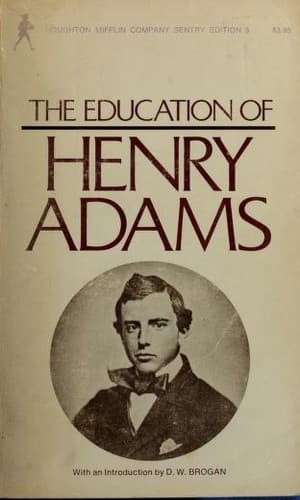
Adams, Henry, 1838-1918; Historians -- United States -- Biography
Young Adams had nothing to do with law; that was business of
his betters. His opinion of law hung on his opinion of lawyers. In
spite of Thurlow Weed's advice, could one afford to trust human nature
in politics? History said not. Sir Robert Collier seemed to hold that
Law agreed with History. For education the point was vital. If one
could not trust a dozen of the most respected private characters in the
world, composing the Queen's Ministry, one could trust no mortal man.
Lord Russell felt the force of this inference, and undertook to
disprove it. His effort lasted till his death. At first he excused
himself by throwing the blame on the law officers. This was a
politician's practice, and the lawyers overruled it. Then he pleaded
guilty to criminal negligence, and said in his "Recollections":--"I
assent entirely to the opinion of the Lord Chief Justice of England
that the Alabama ought to have been detained during the four days I was
waiting for the opinion of the law officers. But I think that the fault
was not that of the commissioners of customs, it was my fault as
Secretary of State for Foreign Affairs." This concession brought all
parties on common ground. Of course it was his fault! The true issue
lay not in the question of his fault, but of his intent. To a young
man, getting an education in politics, there could be no sense in
history unless a constant course of faults implied a constant motive.
For his father the question was not so abstruse; it was a
practical matter of business to be handled as Weed or Evarts handled
their bargains and jobs. Minister Adams held the convenient belief
that, in the main, Russell was true, and the theory answered his
purposes so well that he died still holding it. His son was seeking
education, and wanted to know whether he could, in politics, risk
trusting any one. Unfortunately no one could then decide; no one knew
the facts. Minister Adams died without knowing them. Henry Adams was an
older man than his father in 1862, before he learned a part of them.
The most curious fact, even then, was that Russell believed in his own
good faith and that Argyll believed in it also.
Argyll betrayed a taste for throwing the blame on Bethell, Lord
Westbury, then Lord Chancellor, but this escape helped Adams not at
all. On the contrary, it complicated the case of Russell. In England,
one half of society enjoyed throwing stones at Lord Palmerston, while
the other half delighted in flinging mud at Earl Russell, but every one
of every party united in pelting Westbury with every missile at hand.
The private secretary had no doubts about him, for he never professed
to be moral. He was the head and heart of the whole rebel contention,
and his opinions on neutrality were as clear as they were on morality.
The private secretary had nothing to do with him, and regretted it, for
Lord Westbury's wit and wisdom were great; but as far as his authority
went he affirmed the law that in politics no man should be trusted.
Public-domain text, read in full here on John Shaqi.
Reviews
Reviews
No reviews yet
Be the first to share your thoughts on this work.
Elsewhere in the archive
Join the Discussion
Join the discussion
Sign in to leave a comment or review.
Sign InorCreate an account