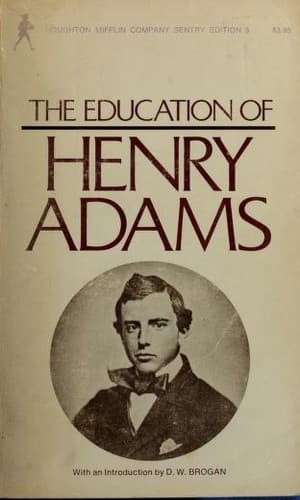
Adams, Henry, 1838-1918; Historians -- United States -- Biography
... His lordship took my allusion at once, though not
without a slight indication of embarrassment. He said that Mr.
Gladstone had been evidently much misunderstood. I must have
seen in the newspapers the letters which contained his later
explanations. That he had certain opinions in regard to the
nature of the struggle in America, as on all public questions,
just as other Englishmen had, was natural enough. And it was
the fashion here for public men to express such as they held in
their public addresses. Of course it was not for him to disavow
anything on the part of Mr. Gladstone; but he had no idea that
in saying what he had, there was a serious intention to justify
any of the inferences that had been drawn from it of a
disposition in the Government now to adopt a new policy....
A student trying to learn the processes of politics in a free
government could not but ponder long on the moral to be drawn from this
"explanation" of Mr. Gladstone by Earl Russell. The point set for study
as the first condition of political life, was whether any politician
could be believed or trusted. The question which a private secretary
asked himself, in copying this despatch of October 24, 1862, was
whether his father believed, or should believe, one word of Lord
Russell's "embarrassment." The "truth" was not known for thirty years,
but when published, seemed to be the reverse of Earl Russell's
statement. Mr. Gladstone's speech had been drawn out by Russell's own
policy of intervention and had no sense except to declare the
"disposition in the Government now to adopt" that new policy. Earl
Russell never disavowed Gladstone, although Lord Palmerston and Sir
George Cornewall Lewis instantly did so. As far as the curious student
could penetrate the mystery, Gladstone exactly expressed Earl Russell's
intent.
As political education, this lesson was to be crucial; it would
decide the law of life. All these gentlemen were superlatively
honorable; if one could not believe them, Truth in politics might be
ignored as a delusion. Therefore the student felt compelled to reach
some sort of idea that should serve to bring the case within a general
law. Minister Adams felt the same compulsion. He bluntly told Russell
that while he was "willing to acquit" Gladstone of "any deliberate
intention to bring on the worst effects," he was bound to say that
Gladstone was doing it quite as certainly as if he had one; and to this
charge, which struck more sharply at Russell's secret policy than at
Gladstone's public defence of it, Russell replied as well as he could:--
Public-domain text, read in full here on John Shaqi.
Reviews
Reviews
No reviews yet
Be the first to share your thoughts on this work.
Elsewhere in the archive
Join the Discussion
Join the discussion
Sign in to leave a comment or review.
Sign InorCreate an account