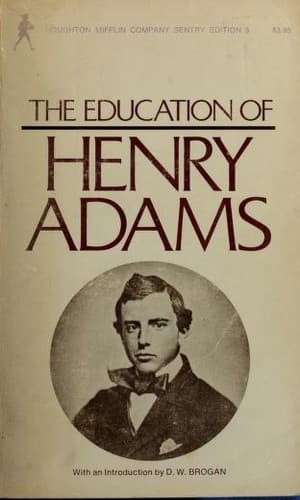
Adams, Henry, 1838-1918; Historians -- United States -- Biography
MINISTER ADAMS troubled himself little about what he did not
see of an enemy. His son, a nervous animal, made life a terror by
seeing too much. Minister Adams played his hand as it came, and seldom
credited his opponents with greater intelligence than his own. Earl
Russell suited him; perhaps a certain personal sympathy united them;
and indeed Henry Adams never saw Russell without being amused by his
droll likeness to John Quincy Adams. Apart from this shadowy personal
relation, no doubt the Minister was diplomatically right; he had
nothing to lose and everything to gain by making a friend of the
Foreign Secretary, and whether Russell were true or false mattered
less, because, in either case, the American Legation could act only as
though he were false. Had the Minister known Russell's determined
effort to betray and ruin him in October, 1862, he could have scarcely
used stronger expressions than he did in 1863. Russell must have been
greatly annoyed by Sir Robert Collier's hint of collusion with the
rebel agents in the Alabama Case, but he hardened himself to hear the
same innuendo repeated in nearly every note from the Legation. As time
went on, Russell was compelled, though slowly, to treat the American
Minister as serious. He admitted nothing so unwillingly, for the
nullity or fatuity of the Washington Government was his idee fixe; but
after the failure of his last effort for joint intervention on November
12, 1862, only one week elapsed before he received a note from Minister
Adams repeating his charges about the Alabama, and asking in very plain
language for redress. Perhaps Russell's mind was naturally slow to
understand the force of sudden attack, or perhaps age had affected it;
this was one of the points that greatly interested a student, but young
men have a passion for regarding their elders as senile, which was only
in part warranted in this instance by observing that Russell's
generation were mostly senile from youth. They had never got beyond
1815. Both Palmerston and Russell were in this case. Their senility was
congenital, like Gladstone's Oxford training and High Church illusions,
which caused wild eccentricities in his judgment. Russell could not
conceive that he had misunderstood and mismanaged Minister Adams from
the start, and when after November 12 he found himself on the
defensive, with Mr Adams taking daily a stronger tone, he showed mere
confusion and helplessness.
Public-domain text, read in full here on John Shaqi.
Reviews
Reviews
No reviews yet
Be the first to share your thoughts on this work.
Elsewhere in the archive
Join the Discussion
Join the discussion
Sign in to leave a comment or review.
Sign InorCreate an account