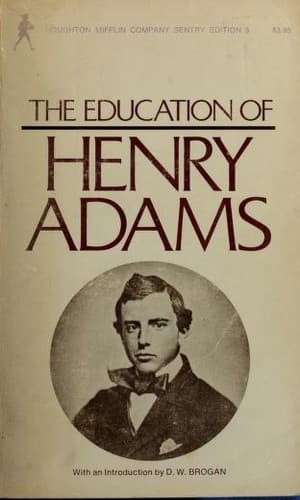
Adams, Henry, 1838-1918; Historians -- United States -- Biography
Even before the military climax at Vicksburg and Gettysburg,
the Minister had been compelled to begin his attack; but this was
history, and had nothing to do with education. The private secretary
copied the notes into his private books, and that was all the share he
had in the matter, except to talk in private.
No more volunteer services were needed; the volunteers were in
a manner sent to the rear; the movement was too serious for
skirmishing. All that a secretary could hope to gain from the affair
was experience and knowledge of politics. He had a chance to measure
the motive forces of men; their qualities of character; their
foresight; their tenacity of purpose.
In the Legation no great confidence was felt in stopping the
rams. Whatever the reason, Russell seemed immovable. Had his efforts
for intervention in September, 1862, been known to the Legation in
September, 1863 the Minister must surely have admitted that Russell
had, from the first, meant to force his plan of intervention on his
colleagues. Every separate step since April, 1861, led to this final
coercion. Although Russell's hostile activity of 1862 was still
secret--and remained secret for some five-and-twenty years--his animus
seemed to be made clear by his steady refusal to stop the rebel
armaments. Little by little, Minister Adams lost hope. With loss of
hope came the raising of tone, until at last, after stripping Russell
of every rag of defence and excuse, he closed by leaving him loaded
with connivance in the rebel armaments, and ended by the famous
sentence: "It would be superfluous in me to point out to your lordship
that this is war!"
What the Minister meant by this remark was his own affair; what the
private secretary understood by it, was a part of his education. Had
his father ordered him to draft an explanatory paragraph to expand the
idea as he grasped it, he would have continued thus:--
"It would be superfluous: 1st. Because Earl Russell not only
knows it already, but has meant it from the start. 2nd Because it is
the only logical and necessary consequence of his unvarying action. 3d.
Because Mr. Adams is not pointing out to him that 'this is war,' but is
pointing it out to the world, to complete the record."
This would have been the matter-of-fact sense in which the
private secretary copied into his books the matter-of-fact statement
with which, without passion or excitement, the Minister announced that
a state of war existed. To his copying eye, as clerk, the words, though
on the extreme verge of diplomatic propriety, merely stated a fact,
without novelty, fancy, or rhetoric. The fact had to be stated in order
to make clear the issue. The war was Russell's war--Adams only accepted
it.
Public-domain text, read in full here on John Shaqi.
Reviews
Reviews
No reviews yet
Be the first to share your thoughts on this work.
Elsewhere in the archive
Join the Discussion
Join the discussion
Sign in to leave a comment or review.
Sign InorCreate an account