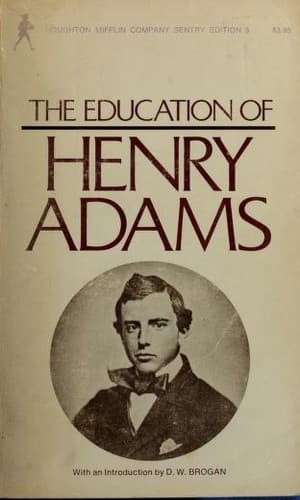
Adams, Henry, 1838-1918; Historians -- United States -- Biography
"Privilege thinks it has a great interest in the American
contest," he began in his massive, deliberate tones; "and every morning
with blatant voice, it comes into our streets and curses the American
Republic. Privilege has beheld an afflicting spectacle for many years
past. It has beheld thirty million of men happy and prosperous, without
emperors--without king (cheers)--without the surroundings of a court
(renewed cheers)--without nobles, except such as are made by eminence
in intellect and virtue--without State bishops and State priests, those
vendors of the love that works salvation (cheers)--without great armies
and great navies--without a great debt and great taxes--and Privilege
has shuddered at what might happen to old Europe if this great
experiment should succeed."
An ingenious man, with an inventive mind, might have managed,
in the same number of lines, to offend more Englishmen than Bright
struck in this sentence; but he must have betrayed artifice and hurt
his oratory. The audience cheered furiously, and the private secretary
felt peace in his much troubled mind, for he knew how careful the
Ministry would be, once they saw Bright talk republican principles
before Trades-Unions; but, while he did not, like Roebuck, see reason
to doubt the courage of a man who, after quarrelling with the
Trades-Unions, quarreled with all the world outside the Trades-Unions,
he did feel a doubt whether to class Bright as eccentric or
conventional. Every one called Bright "un-English," from Lord
Palmerston to William E. Forster; but to an American he seemed more
English than any of his critics. He was a liberal hater, and what he
hated he reviled after the manner of Milton, but he was afraid of no
one. He was almost the only man in England, or, for that matter, in
Europe, who hated Palmerston and was not afraid of him, or of the press
or the pulpit, the clubs or the bench, that stood behind him. He
loathed the whole fabric of sham religion, sham loyalty, sham
aristocracy, and sham socialism. He had the British weakness of
believing only in himself and his own conventions. In all this, an
American saw, if one may make the distinction, much racial
eccentricity, but little that was personal. Bright was singularly well
poised; but he used singularly strong language.
Public-domain text, read in full here on John Shaqi.
Reviews
Reviews
No reviews yet
Be the first to share your thoughts on this work.
Elsewhere in the archive
Join the Discussion
Join the discussion
Sign in to leave a comment or review.
Sign InorCreate an account