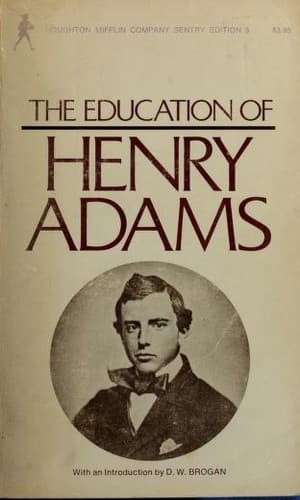
Adams, Henry, 1838-1918; Historians -- United States -- Biography
Adams felt no moral obligation to defend Judges, who, as far as
he knew, were the only class of society specially adapted to defend
themselves; but he was curious--even anxious--as a point of education,
to decide for himself whether Bright's language was violent for its
purpose. He thought not. Perhaps Cobden did better by persuasion, but
that was another matter. Of course, even Englishmen sometimes
complained of being so constantly told that they were brutes and
hypocrites, although they were told little else by their censors, and
bore it, on the whole, meekly; but the fact that it was true in the
main troubled the ten-pound voter much less than it troubled Newman,
Gladstone, Ruskin, Carlyle, and Matthew Arnold. Bright was personally
disliked by his victims, but not distrusted. They never doubted what he
would do next, as they did with John Russell, Gladstone, and Disraeli.
He betrayed no one, and he never advanced an opinion in practical
matters which did not prove to be practical.
The class of Englishmen who set out to be the intellectual
opposites of Bright, seemed to an American bystander the weakest and
most eccentric of all. These were the trimmers, the political
economists, the anti-slavery and doctrinaire class, the followers of de
Tocqueville, and of John Stuart Mill. As a class, they were timid--with
good reason--and timidity, which is high wisdom in philosophy, sicklies
the whole cast of thought in action. Numbers of these men haunted
London society, all tending to free-thinking, but never venturing much
freedom of thought. Like the anti-slavery doctrinaires of the forties
and fifties, they became mute and useless when slavery struck them in
the face. For type of these eccentrics, literature seems to have chosen
Henry Reeve, at least to the extent of biography. He was a bulky figure
in society, always friendly, good-natured, obliging, and useful; almost
as universal as Milnes and more busy. As editor of the Edinburgh Review
he had authority and even power, although the Review and the whole Whig
doctrinaire school had begun--as the French say--to date; and of course
the literary and artistic sharpshooters of 1867--like Frank
Palgrave--frothed and foamed at the mere mention of Reeve's name.
Three-fourths of their fury was due only to his ponderous manner.
London society abused its rights of personal criticism by fixing on
every too conspicuous figure some word or phrase that stuck to it.
Every one had heard of Mrs. Grote as "the origin of the word
grotesque." Every one had laughed at the story of Reeve approaching
Mrs. Grote, with his usual somewhat florid manner, asking in his
literary dialect how her husband the historian was: "And how is the
learned Grotius?" "Pretty well, thank you, Puffendorf!" One winced at
the word, as though it were a drawing of Forain.
Public-domain text, read in full here on John Shaqi.
Reviews
Reviews
No reviews yet
Be the first to share your thoughts on this work.
Elsewhere in the archive
Join the Discussion
Join the discussion
Sign in to leave a comment or review.
Sign InorCreate an account