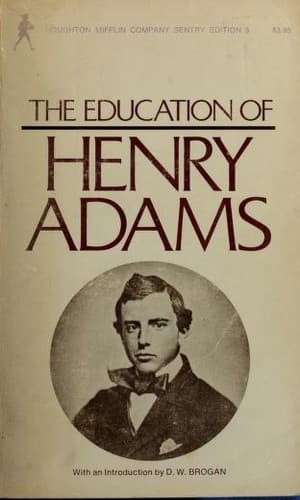
Adams, Henry, 1838-1918; Historians -- United States -- Biography
No one would have been more shocked than Reeve had he been
charged with want of moral courage. He proved his courage afterwards by
publishing the "Greville Memoirs," braving the displeasure of the
Queen. Yet the Edinburgh Review and its editor avoided taking sides
except where sides were already fixed. Americanism would have been bad
form in the liberal Edinburgh Review; it would have seemed eccentric
even for a Scotchman, and Reeve was a Saxon of Saxons. To an American
this attitude of oscillating reserve seemed more eccentric than the
reckless hostility of Brougham or Carlyle, and more mischievous, for he
never could be sure what preposterous commonplace it might encourage.
The sum of these experiences in 1863 left the conviction that
eccentricity was weakness. The young American who should adopt English
thought was lost. From the facts, the conclusion was correct, yet, as
usual, the conclusion was wrong. The years of Palmerston's last
Cabinet, 1859 to 1865, were avowedly years of truce--of arrested
development. The British system like the French, was in its last stage
of decomposition. Never had the British mind shown itself so
decousu--so unravelled, at sea, floundering in every sort of historical
shipwreck. Eccentricities had a free field. Contradictions swarmed in
State and Church. England devoted thirty years of arduous labor to
clearing away only a part of the debris. A young American in 1863 could
see little or nothing of the future. He might dream, but he could not
foretell, the suddenness with which the old Europe, with England in its
wake, was to vanish in 1870. He was in dead-water, and the
parti-colored, fantastic cranks swam about his boat, as though he were
the ancient mariner, and they saurians of the prime.
CHAPTER XIII
THE PERFECTION OF HUMAN SOCIETY (1864)
MINISTER ADAMS'S success in stopping the rebel rams fixed his
position once for all in English society. From that moment he could
afford to drop the character of diplomatist, and assume what, for an
American Minister in London, was an exclusive diplomatic advantage, the
character of a kind of American Peer of the Realm. The British never
did things by halves. Once they recognized a man's right to social
privileges, they accepted him as one of themselves. Much as Lord Derby
and Mr. Disraeli were accepted as leaders of Her Majesty's domestic
Opposition, Minister Adams had a rank of his own as a kind of leader of
Her Majesty's American Opposition. Even the Times conceded it. The
years of struggle were over, and Minister Adams rapidly gained a
position which would have caused his father or grandfather to stare
with incredulous envy.
Public-domain text, read in full here on John Shaqi.
Reviews
Reviews
No reviews yet
Be the first to share your thoughts on this work.
Elsewhere in the archive
Join the Discussion
Join the discussion
Sign in to leave a comment or review.
Sign InorCreate an account