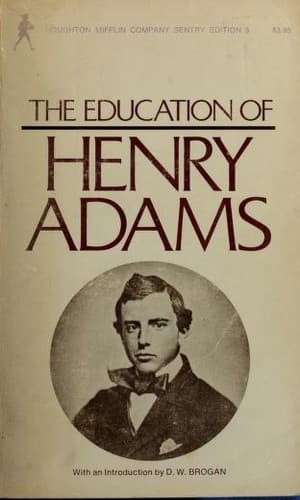
Adams, Henry, 1838-1918; Historians -- United States -- Biography
Always conscious of this barrier, while the war lasted the
private secretary hid himself among the herd of foreigners till he
found his relations fixed and unchangeable. He never felt himself in
society, and he never knew definitely what was meant as society by
those who were in it. He saw far enough to note a score of societies
which seemed quite independent of each other. The smartest was the
smallest, and to him almost wholly strange. The largest was the
sporting world, also unknown to him except through the talk of his
acquaintances. Between or beyond these lay groups of nebulous
societies. His lawyer friends, like Evarts, frequented legal circles
where one still sat over the wine and told anecdotes of the bench and
bar; but he himself never set eyes on a judge except when his father
took him to call on old Lord Lyndhurst, where they found old Lord
Campbell, both abusing old Lord Brougham. The Church and the Bishops
formed several societies which no secretary ever saw except as an
interloper. The Army; the Navy; the Indian Service; the medical and
surgical professions; City people; artists; county families; the
Scotch, and indefinite other subdivisions of society existed, which
were as strange to each other as they were to Adams. At the end of
eight or ten seasons in London society he professed to know less about
it, or how to enter it, than he did when he made his first appearance
at Miss Burdett Coutts's in May, 1861.
Sooner or later every young man dropped into a set or circle,
and frequented the few houses that were willing to harbor him. An
American who neither hunted nor raced, neither shot nor fished nor
gambled, and was not marriageable, had no need to think of society at
large. Ninety-nine houses in every hundred were useless to him, a
greater bore to him than he to them. Thus the question of getting
into--or getting out of--society which troubled young foreigners
greatly, settled itself after three or four years of painful
speculation. Society had no unity; one wandered about in it like a
maggot in cheese; it was not a hansom cab, to be got into, or out of,
at dinner-time.
Therefore he always professed himself ignorant of society; he
never knew whether he had been in it or not, but from the accounts of
his future friends, like General Dick Taylor or George Smalley, and of
various ladies who reigned in the seventies, he inclined to think that
he knew very little about it. Certain great houses and certain great
functions of course he attended, like every one else who could get
cards, but even of these the number was small that kept an interest or
helped education. In seven years he could remember only two that seemed
to have any meaning for him, and he never knew what that meaning was.
Neither of the two was official; neither was English in interest; and
both were scandals to the philosopher while they scarcely enlightened
men of the world.
Public-domain text, read in full here on John Shaqi.
Reviews
Reviews
No reviews yet
Be the first to share your thoughts on this work.
Elsewhere in the archive
Join the Discussion
Join the discussion
Sign in to leave a comment or review.
Sign InorCreate an account