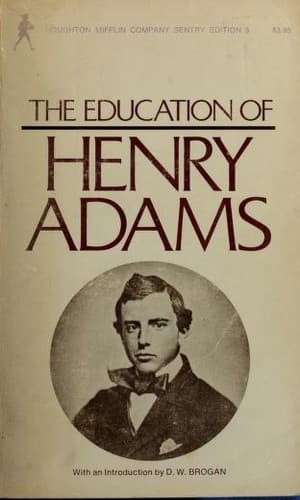
Adams, Henry, 1838-1918; Historians -- United States -- Biography
Society of this sort might fit a young man in some degree for
editing Shakespeare or Swift, but had little relation with the society
of 1870, and none with that of 1900. Owing to other causes, young Adams
never got the full training of such style as still existed. The
embarrassments of his first few seasons socially ruined him. His own
want of experience prevented his asking introductions to the ladies who
ruled society; his want of friends prevented his knowing who these
ladies were; and he had every reason to expect snubbing if he put
himself in evidence. This sensitiveness was thrown away on English
society, where men and women treated each others' advances much more
brutally than those of strangers, but young Adams was son and private
secretary too; he could not be as thick-skinned as an Englishman. He
was not alone. Every young diplomat, and most of the old ones, felt
awkward in an English house from a certainty that they were not
precisely wanted there, and a possibility that they might be told so.
If there was in those days a country house in England which had
a right to call itself broad in views and large in tastes, it was
Bretton in Yorkshire; and if there was a hostess who had a right to
consider herself fashionable as well as charming, it was Lady Margaret
Beaumont; yet one morning at breakfast there, sitting by her side--not
for his own merits--Henry Adams heard her say to herself in her languid
and liberal way, with her rich voice and musing manner, looking into
her tea-cup: "I don't think I care for foreigners!" Horror-stricken,
not so much on his own account as on hers, the young man could only
execute himself as gaily as he might: "But Lady Margaret, please make
one small exception for me!" Of course she replied what was evident,
that she did not call him a foreigner, and her genial Irish charm made
the slip of tongue a happy courtesy; but none the less she knew that,
except for his momentary personal introduction, he was in fact a
foreigner, and there was no imaginable reason why she should like him,
or any other foreigner, unless it were because she was bored by
natives. She seemed to feel that her indifference needed a reason to
excuse itself in her own eyes, and she showed the subconscious sympathy
of the Irish nature which never feels itself perfectly at home even in
England. She, too, was some shadowy shade un-English.
Public-domain text, read in full here on John Shaqi.
Reviews
Reviews
No reviews yet
Be the first to share your thoughts on this work.
Elsewhere in the archive
Join the Discussion
Join the discussion
Sign in to leave a comment or review.
Sign InorCreate an account