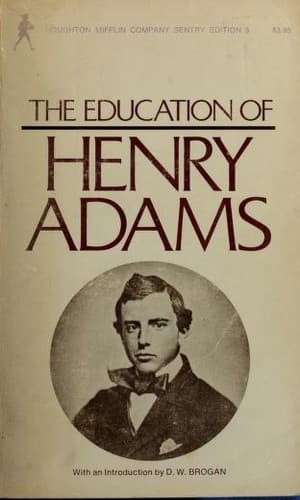
Adams, Henry, 1838-1918; Historians -- United States -- Biography
More than any other county in England, Yorkshire retained a
sort of social independence of London. Scotland itself was hardly more
distinct. The Yorkshire type had always been the strongest of the
British strains; the Norwegian and the Dane were a different race from
the Saxon. Even Lancashire had not the mass and the cultivation of the
West Riding. London could never quite absorb Yorkshire, which, in its
turn had no great love for London and freely showed it. To a certain
degree, evident enough to Yorkshiremen, Yorkshire was not English--or
was all England, as they might choose to express it. This must have
been the reason why young Adams was drawn there rather than elsewhere.
Monckton Milnes alone took the trouble to draw him, and possibly Milnes
was the only man in England with whom Henry Adams, at that moment, had
a chance of calling out such an un-English effort. Neither Oxford nor
Cambridge nor any region south of the Humber contained a considerable
house where a young American would have been sought as a friend.
Eccentricity alone did not account for it. Monckton Milnes was a
singular type, but his distant cousin, James Milnes Gaskell, was
another, quite as marked, in an opposite sense. Milnes never seemed
willing to rest; Milnes Gaskell never seemed willing to move. In his
youth one of a very famous group--Arthur Hallam, Tennyson, Manning,
Gladstone, Francis Doyle--and regarded as one of the most promising; an
adorer of George Canning; in Parliament since coming of age; married
into the powerful connection of the Wynns of Wynstay; rich according to
Yorkshire standards; intimate with his political leaders; he was one of
the numerous Englishmen who refuse office rather than make the effort
of carrying it, and want power only to make it a source of indolence.
He was a voracious reader and an admirable critic; he had forty years
of parliamentary tradition on his memory; he liked to talk and to
listen; he liked his dinner and, in spite of George Canning, his dry
champagne; he liked wit and anecdote; but he belonged to the generation
of 1830, a generation which could not survive the telegraph and
railway, and which even Yorkshire could hardly produce again. To an
American he was a character even more unusual and more fascinating than
his distant cousin Lord Houghton.
Public-domain text, read in full here on John Shaqi.
Reviews
Reviews
No reviews yet
Be the first to share your thoughts on this work.
Elsewhere in the archive
Join the Discussion
Join the discussion
Sign in to leave a comment or review.
Sign InorCreate an account