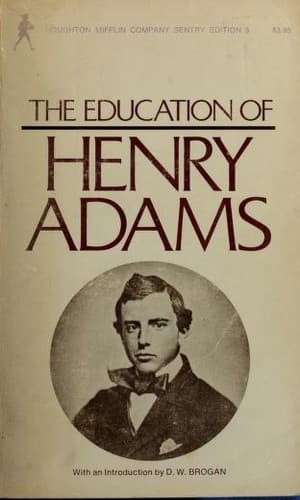
Adams, Henry, 1838-1918; Historians -- United States -- Biography
Mr. Milnes Gaskell was kind to the young American whom his son
brought to the house, and Mrs. Milnes Gaskell was kinder, for she
thought the American perhaps a less dangerous friend than some
Englishman might be, for her son, and she was probably right. The
American had the sense to see that she was herself one of the most
intelligent and sympathetic women in England; her sister, Miss
Charlotte Wynn, was another; and both were of an age and a position in
society that made their friendship a compliment as well as a pleasure.
Their consent and approval settled the matter. In England, the family
is a serious fact; once admitted to it, one is there for life. London
might utterly vanish from one's horizon, but as long as life lasted,
Yorkshire lived for its friends.
In the year 1857, Mr. James Milnes Gaskell, who had sat for
thirty years in Parliament as one of the Members for the borough of
Wenlock in Shropshire, bought Wenlock Abbey and the estate that
included the old monastic buildings. This new, or old, plaything amused
Mrs. Milnes Gaskell. The Prior's house, a charming specimen of
fifteenth-century architecture, had been long left to decay as a
farmhouse. She put it in order, and went there to spend a part of the
autumn of 1864. Young Adams was one of her first guests, and drove
about Wenlock Edge and the Wrekin with her, learning the loveliness of
this exquisite country, and its stores of curious antiquity. It was a
new and charming existence; an experience greatly to be envied--ideal
repose and rural Shakespearian peace--but a few years of it were likely
to complete his education, and fit him to act a fairly useful part in
life as an Englishman, an ecclesiastic, and a contemporary of Chaucer.
CHAPTER XIV
DILETTANTISM (1865-1866)
THE campaign of 1864 and the reelection of Mr. Lincoln in
November set the American Minister on so firm a footing that he could
safely regard his own anxieties as over, and the anxieties of Earl
Russell and the Emperor Napoleon as begun. With a few months more his
own term of four years would come to an end, and even though the
questions still under discussion with England should somewhat prolong
his stay, he might look forward with some confidence to his return home
in 1865. His son no longer fretted. The time for going into the army
had passed. If he were to be useful at all, it must be as a son, and as
a son he was treated with the widest indulgence and trust. He knew that
he was doing himself no good by staying in London, but thus far in life
he had done himself no good anywhere, and reached his twenty-seventh
birthday without having advanced a step, that he could see, beyond his
twenty-first. For the most part, his friends were worse off than he.
The war was about to end and they were to be set adrift in a world they
would find altogether strange.
Public-domain text, read in full here on John Shaqi.
Reviews
Reviews
No reviews yet
Be the first to share your thoughts on this work.
Elsewhere in the archive
Join the Discussion
Join the discussion
Sign in to leave a comment or review.
Sign InorCreate an account