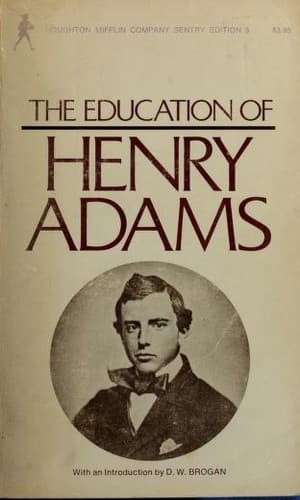
Adams, Henry, 1838-1918; Historians -- United States -- Biography
All his American friends and contemporaries who were still
alive looked singularly commonplace without uniforms, and hastened to
get married and retire into back streets and suburbs until they could
find employment. Minister Adams, too, was going home "next fall," and
when the fall came, he was going home "next spring," and when the
spring came, President Andrew Johnson was at loggerheads with the
Senate, and found it best to keep things unchanged. After the usual
manner of public servants who had acquired the habit of office and lost
the faculty of will, the members of the Legation in London continued
the daily routine of English society, which, after becoming a habit,
threatened to become a vice. Had Henry Adams shared a single taste with
the young Englishmen of his time, he would have been lost; but the
custom of pounding up and down Rotten Row every day, on a hack, was not
a taste, and yet was all the sport he shared. Evidently he must set to
work; he must get a new education; he must begin a career of his own.
Nothing was easier to say, but even his father admitted two
careers to be closed. For the law, diplomacy had unfitted him; for
diplomacy he already knew too much. Any one who had held, during the
four most difficult years of American diplomacy, a position at the
centre of action, with his hands actually touching the lever of power,
could not beg a post of Secretary at Vienna or Madrid in order to bore
himself doing nothing until the next President should do him the honor
to turn him out. For once all his advisers agreed that diplomacy was
not possible.
In any ordinary system he would have been called back to serve
in the State Department, but, between the President and the Senate,
service of any sort became a delusion. The choice of career was more
difficult than the education which had proved impracticable. Adams saw
no road; in fact there was none. All his friends were trying one path
or another, but none went a way that he could have taken. John Hay
passed through London in order to bury himself in second-rate Legations
for years, before he drifted home again to join Whitelaw Reid and
George Smalley on the Tribune. Frank Barlow and Frank Bartlett carried
Major-Generals' commissions into small law business. Miles stayed in
the army. Henry Higginson, after a desperate struggle, was forced into
State Street; Charles Adams wandered about, with brevet-brigadier rank,
trying to find employment. Scores of others tried experiments more or
less unsuccessful. Henry Adams could see easy ways of making a hundred
blunders; he could see no likely way of making a legitimate success.
Such as it was, his so-called education was wanted nowhere.
Public-domain text, read in full here on John Shaqi.
Reviews
Reviews
No reviews yet
Be the first to share your thoughts on this work.
Elsewhere in the archive
Join the Discussion
Join the discussion
Sign in to leave a comment or review.
Sign InorCreate an account