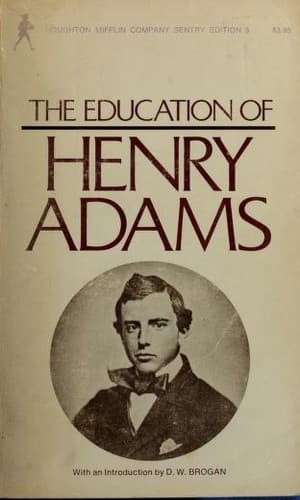
Adams, Henry, 1838-1918; Historians -- United States -- Biography
One profession alone seemed possible--the press. In 1860 he
would have said that he was born to be an editor, like at least a
thousand other young graduates from American colleges who entered the
world every year enjoying the same conviction; but in 1866 the
situation was altered; the possession of money had become doubly
needful for success, and double energy was essential to get money.
America had more than doubled her scale. Yet the press was still the
last resource of the educated poor who could not be artists and would
not be tutors. Any man who was fit for nothing else could write an
editorial or a criticism. The enormous mass of misinformation
accumulated in ten years of nomad life could always be worked off on a
helpless public, in diluted doses, if one could but secure a table in
the corner of a newspaper office. The press was an inferior pulpit; an
anonymous schoolmaster; a cheap boarding-school but it was still the
nearest approach to a career for the literary survivor of a wrecked
education. For the press, then, Henry Adams decided to fit himself, and
since he could not go home to get practical training, he set to work to
do what he could in London.
He knew, as well as any reporter on the New York Herald, that
this was not an American way of beginning, and he knew a certain number
of other drawbacks which the reporter could not see so clearly. Do what
he might, he drew breath only in the atmosphere of English methods and
thoughts; he could breathe none other. His mother--who should have been
a competent judge, since her success and popularity in England exceeded
that of her husband--averred that every woman who lived a certain time
in England came to look and dress like an Englishwoman, no matter how
she struggled. Henry Adams felt himself catching an English tone of
mind and processes of thought, though at heart more hostile to them
than ever. As though to make him more helpless and wholly distort his
life, England grew more and more agreeable and amusing. Minister Adams
became, in 1866, almost a historical monument in London; he held a
position altogether his own. His old opponents disappeared. Lord
Palmerston died in October, 1865; Lord Russell tottered on six months
longer, but then vanished from power; and in July, 1866, the
conservatives came into office. Traditionally the Tories were easier to
deal with than the Whigs, and Minister Adams had no reason to regret
the change. His personal relations were excellent and his personal
weight increased year by year. On that score the private secretary had
no cares, and not much copy. His own position was modest, but it was
enough; the life he led was agreeable; his friends were all he wanted,
and, except that he was at the mercy of politics, he felt much at ease.
Of his daily life he had only to reckon so many breakfasts; so many
dinners; so many receptions, balls, theatres, and country-parties; so
many cards to be left; so many Americans to be escorted--the usual
Public-domain text, read in full here on John Shaqi.
Reviews
Reviews
No reviews yet
Be the first to share your thoughts on this work.
Elsewhere in the archive
Join the Discussion
Join the discussion
Sign in to leave a comment or review.
Sign InorCreate an account