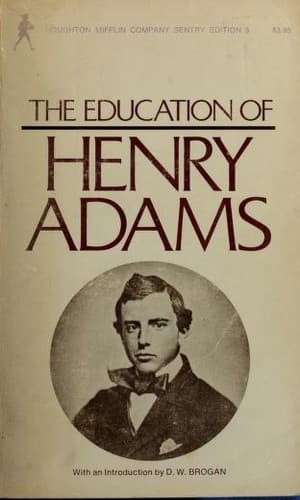
Adams, Henry, 1838-1918; Historians -- United States -- Biography
One morning in early July, 1867, Palgrave stopped at the
Legation in Portland Place on his way downtown, and offered to take
Adams to Sotheby's, where a small collection of old drawings was on
show. The collection was rather a curious one, said to be that of Sir
Anthony Westcomb, from Liverpool, with an undisturbed record of a
century, but with nothing to attract notice. Probably none but
collectors or experts examined the portfolios. Some dozens of these
were always on hand, following every sale, and especially on the
lookout for old drawings, which became rarer every year. Turning
rapidly over the numbers, Palgrave stopped at one containing several
small drawings, one marked as Rembrandt, one as Rafael; and putting his
finger on the Rafael, after careful examination; "I should buy this,"
he said; "it looks to me like one of those things that sell for five
shillings one day, and fifty pounds the next." Adams marked it for a
bid, and the next morning came down to the auction. The numbers sold
slowly, and at noon he thought he might safely go to lunch. When he
came back, half an hour afterwards, the drawing was gone. Much annoyed
at his own stupidity, since Palgrave had expressly said he wanted the
drawing for himself if he had not in a manner given it to Adams, the
culprit waited for the sale to close, and then asked the clerk for the
name of the buyer. It was Holloway, the art-dealer, near Covent Garden,
whom he slightly knew. Going at once to the shop he waited till young
Holloway came in, with his purchases under his arm, and without attempt
at preface, he said: "You bought to-day, Mr. Holloway, a number that I
wanted. Do you mind letting me have it?" Holloway took out the parcel,
looked over the drawings, and said that he had bought the number for
the sake of the Rembrandt, which he thought possibly genuine; taking
that out, Adams might have the rest for the price he paid for the
lot--twelve shillings.
Thus, down to that moment, every expert in London had probably
seen these drawings. Two of them--only two--had thought them worth
buying at any price, and of these two, Palgrave chose the Rafael,
Holloway the one marked as Rembrandt. Adams, the purchaser of the
Rafael, knew nothing whatever on the subject, but thought he might
credit himself with education to the value of twelve shillings, and
call the drawing nothing. Such items of education commonly came higher.
Public-domain text, read in full here on John Shaqi.
Reviews
Reviews
No reviews yet
Be the first to share your thoughts on this work.
Elsewhere in the archive
Join the Discussion
Join the discussion
Sign in to leave a comment or review.
Sign InorCreate an account