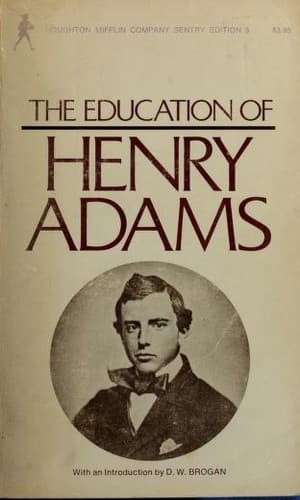
Adams, Henry, 1838-1918; Historians -- United States -- Biography
Palgrave's call on him just after he had moved into his new Queen Anne
house in Kensington Square: "Palgrave called yesterday, and the first
thing he said was, 'I've counted three anachronisms on your front
doorstep.'"
Another savage critic, also a poet, was Thomas Woolner, a type
almost more emphatic than Palgrave in a society which resounded with
emphasis. Woolner's sculpture showed none of the rough assertion that
Woolner himself showed, when he was not making supernatural effort to
be courteous, but his busts were remarkable, and his work altogether
was, in Palgrave's clamorous opinion, the best of his day. He took the
matter of British art--or want of art--seriously, almost ferociously,
as a personal grievance and torture; at times he was rather terrifying
in the anarchistic wrath of his denunciation. As Henry Adams felt no
responsibility for English art, and had no American art to offer for
sacrifice, he listened with enjoyment to language much like Carlyle's,
and accepted it without a qualm. On the other hand, as a third member
of this critical group, he fell in with Stopford Brooke whose tastes
lay in the same direction, and whose expression was modified by
clerical propriety. Among these men, one wandered off into paths of
education much too devious and slippery for an American foot to follow.
He would have done better to go on the race-track, as far as concerned
a career.
Fortunately for him he knew too little ever to be an
art-critic, still less an artist. For some things ignorance is good,
and art is one of them. He knew he knew nothing, and had not the
trained eye or the keen instinct that trusted itself; but he was
curious, as he went on, to find out how much others knew. He took
Palgrave's word as final about a drawing of Rembrandt or Michael
Angelo, and he trusted Woolner implicitly about a Turner; but when he
quoted their authority to any dealer, the dealer pooh-poohed it, and
declared that it had no weight in the trade. If he went to a sale of
drawings or paintings, at Sotheby's or Christie's, an hour afterwards,
he saw these same dealers watching Palgrave or Woolner for a point, and
bidding over them. He rarely found two dealers agree in judgment. He
once bought a water-color from the artist himself out of his studio,
and had it doubted an hour afterwards by the dealer to whose place he
took it for framing. He was reduced to admit that he could not prove its
authenticity; internal evidence was against it.
Public-domain text, read in full here on John Shaqi.
Reviews
Reviews
No reviews yet
Be the first to share your thoughts on this work.
Elsewhere in the archive
Join the Discussion
Join the discussion
Sign in to leave a comment or review.
Sign InorCreate an account