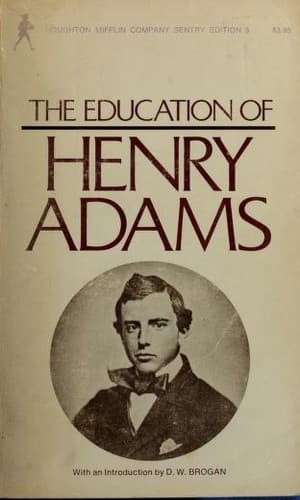
Adams, Henry, 1838-1918; Historians -- United States -- Biography
This expert broke down on the alphabet! He could not even judge
a manuscript; but Adams had no right to complain, for he had nothing to
pay, not even twelve shillings, though he thought these experts worth
more, at least for his education. Accordingly he carried his paper to
Libri, a total stranger to him, and asked the old man, as deferentially
as possible, to tell him whether the lines had any meaning. Had Adams
not been an ignorant person he would have known all about Libri, but
his ignorance was vast, and perhaps was for the best. Libri looked at
the paper, and then looked again, and at last bade him sit down and
wait. Half an hour passed before he called Adams back and showed him
these lines:--
"Or questo credo ben che una elleria
Te offende tanto che te offese il core.
Perche sei grande nol sei in tua volia;
Tu vedi e gia non credi il tuo valore;
Passate gia son tutte gelosie;
Tu sei di sasso; non hai piu dolore."
As far as Adams could afterwards recall it, this was Libri's
reading, but he added that the abbreviations were many and unusual;
that the writing was very ancient; and that the word he read as
"elleria" in the first line was not Italian at all.
By this time, one had got too far beyond one's depth to ask
questions. If Libri could not read Italian, very clearly Adams had
better not offer to help him. He took the drawing, thanked everybody,
and having exhausted the experts of the British Museum, took a cab to
Woolner's studio, where he showed the figure and repeated Reed's
opinion. Woolner snorted: "Reed's a fool!" he said; "he knows nothing
about it; there may be a rotten line or two, but the drawing's all
right."
For forty years Adams kept this drawing on his mantelpiece,
partly for its own interest, but largely for curiosity to see whether
any critic or artist would ever stop to look at it. None ever did,
unless he knew the story. Adams himself never wanted to know more about
it. He refused to seek further light. He never cared to learn whether
the drawing was Rafael's, or whether the verse was Rafael's, or
whether even the water-mark was Rafael's. The experts--some scores of
them including the British Museum,--had affirmed that the drawing was
worth a certain moiety of twelve shillings. On that point, also, Adams
could offer no opinion, but he was clear that his education had
profited by it to that extent--his amusement even more.
Public-domain text, read in full here on John Shaqi.
Reviews
Reviews
No reviews yet
Be the first to share your thoughts on this work.
Elsewhere in the archive
Join the Discussion
Join the discussion
Sign in to leave a comment or review.
Sign InorCreate an account