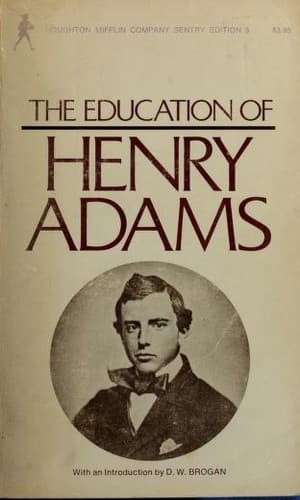
Adams, Henry, 1838-1918; Historians -- United States -- Biography
Art was a superb field for education, but at every turn he met
the same old figure, like a battered and illegible signpost that ought
to direct him to the next station but never did. There was no next
station. All the art of a thousand--or ten thousand--years had brought
England to stuff which Palgrave and Woolner brayed in their mortars;
derided, tore in tatters, growled at, and howled at, and treated in
terms beyond literary usage. Whistler had not yet made his appearance
in London, but the others did quite as well. What result could a
student reach from it? Once, on returning to London, dining with
Stopford Brooke, some one asked Adams what impression the Royal Academy
Exhibition made on him. With a little hesitation, he suggested that it
was rather a chaos, which he meant for civility; but Stopford Brooke
abruptly met it by asking whether chaos were not better than death.
Truly the question was worth discussion. For his own part, Adams
inclined to think that neither chaos nor death was an object to him as
a searcher of knowledge--neither would have vogue in America--neither
would help him to a career. Both of them led him away from his objects,
into an English dilettante museum of scraps, with nothing but a
wall-paper to unite them in any relation of sequence. Possibly English
taste was one degree more fatal than English scholarship, but even this
question was open to argument. Adams went to the sales and bought what
he was told to buy; now a classical drawing by Rafael or Rubens; now a
water-color by Girtin or Cotman, if possible unfinished because it was
more likely to be a sketch from nature; and he bought them not because
they went together--on the contrary, they made rather awkward spots on
the wall as they did on the mind--but because he could afford to buy
those, and not others. Ten pounds did not go far to buy a Michael
Angelo, but was a great deal of money to a private secretary. The
effect was spotty, fragmentary, feeble; and the more so because the
British mind was constructed in that way--boasted of it, and held it to
be true philosophy as well as sound method.
Public-domain text, read in full here on John Shaqi.
Reviews
Reviews
No reviews yet
Be the first to share your thoughts on this work.
Elsewhere in the archive
Join the Discussion
Join the discussion
Sign in to leave a comment or review.
Sign InorCreate an account