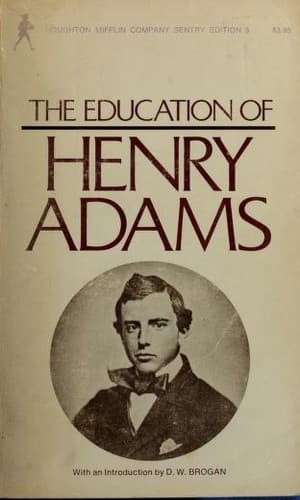
Adams, Henry, 1838-1918; Historians -- United States -- Biography
Whether Henry Adams knew it or not, he knew enough to act as
though he did. He reached Quincy once more, ready for the new start.
His brother Charles had determined to strike for the railroads; Henry
was to strike for the press; and they hoped to play into each other's
hands. They had great need, for they found no one else to play with.
After discovering the worthlessness of a so-called education, they had
still to discover the worthlessness of so-called social connection. No
young man had a larger acquaintance and relationship than Henry Adams,
yet he knew no one who could help him. He was for sale, in the open
market. So were many of his friends. All the world knew it, and knew
too that they were cheap; to be bought at the price of a mechanic.
There was no concealment, no delicacy, and no illusion about it.
Neither he nor his friends complained; but he felt sometimes a little
surprised that, as far as he knew, no one, seeking in the labor market,
ever so much as inquired about their fitness. The want of solidarity
between old and young seemed American. The young man was required to
impose himself, by the usual business methods, as a necessity on his
elders, in order to compel them to buy him as an investment. As Adams
felt it, he was in a manner expected to blackmail. Many a young man
complained to him in after life of the same experience, which became a
matter of curious reflection as he grew old. The labor market of good
society was ill-organized.
Boston seemed to offer no market for educated labor. A peculiar
and perplexing amalgam Boston always was, and although it had changed
much in ten years, it was not less perplexing. One no longer dined at
two o'clock; one could no longer skate on Back Bay; one heard talk of
Bostonians worth five millions or more as something not incredible. Yet
the place seemed still simple, and less restless-minded than ever
before. In the line that Adams had chosen to follow, he needed more
than all else the help of the press, but any shadow of hope on that
side vanished instantly. The less one meddled with the Boston press,
the better. All the newspapermen were clear on that point. The same was
true of politics. Boston meant business. The Bostonians were building
railways. Adams would have liked to help in building railways, but had
no education. He was not fit.
He passed three or four months thus, visiting relations,
renewing friendships, and studying the situation. At thirty years old,
the man who has not yet got further than to study the situation, is
lost, or near it. He could see nothing in the situation that could be
of use to him. His friends had won no more from it than he. His brother
Charles, after three years of civil life, was no better off than
himself, except for being married and in greater need of income. His
brother John had become a brilliant political leader on the wrong side.
No one had yet regained the lost ground of the war.
Public-domain text, read in full here on John Shaqi.
Reviews
Reviews
No reviews yet
Be the first to share your thoughts on this work.
Elsewhere in the archive
Join the Discussion
Join the discussion
Sign in to leave a comment or review.
Sign InorCreate an account