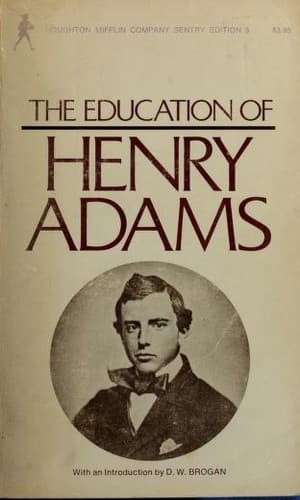
Adams, Henry, 1838-1918; Historians -- United States -- Biography
All this, the newcomer understood and accepted, since he could
not help himself and saw that the American could help himself as little
as the newcomer; but the fact remained that the more he knew, the less
he was educated. Society knew as much as this, and seemed rather
inclined to boast of it, at least on the stump; but the leaders of
industry betrayed no sentiment, popular or other. They used, without
qualm, whatever instruments they found at hand. They had been obliged,
in 1861, to turn aside and waste immense energy in settling what had
been settled a thousand years before, and should never have been
revived. At prodigious expense, by sheer force, they broke resistance
down, leaving everything but the mere fact of power untouched, since
nothing else had a solution. Race and thought were beyond reach. Having
cleared its path so far, society went back to its work, and threw
itself on that which stood first--its roads. The field was vast;
altogether beyond its power to control offhand; and society dropped
every thought of dealing with anything more than the single fraction
called a railway system. This relatively small part of its task was
still so big as to need the energies of a generation, for it required
all the new machinery to be created--capital, banks, mines, furnaces,
shops, power-houses, technical knowledge, mechanical population,
together with a steady remodelling of social and political habits,
ideas, and institutions to fit the new scale and suit the new
conditions. The generation between 1865 and 1895 was already mortgaged
to the railways, and no one knew it better than the generation itself.
Public-domain text, read in full here on John Shaqi.
Reviews
Reviews
No reviews yet
Be the first to share your thoughts on this work.
Elsewhere in the archive
Join the Discussion
Join the discussion
Sign in to leave a comment or review.
Sign InorCreate an account