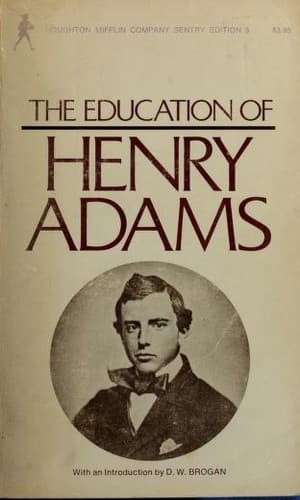
Adams, Henry, 1838-1918; Historians -- United States -- Biography
The first step, of course, was the making of acquaintance, and
the first acquaintance was naturally the President, to whom an aspirant
to the press officially paid respect. Evarts immediately took him to
the White House and presented him to President Andrew Johnson. The
interview was brief and consisted in the stock remark common to
monarchs and valets, that the young man looked even younger than he
was. The younger man felt even younger than he looked. He never saw the
President again, and never felt a wish to see him, for Andrew Johnson
was not the sort of man whom a young reformer of thirty, with two or
three foreign educations, was likely to see with enthusiasm; yet,
musing over the interview as a matter of education, long years
afterwards, he could not help recalling the President's figure with a
distinctness that surprised him. The old-fashioned Southern Senator and
statesman sat in his chair at his desk with a look of self-esteem that
had its value. None doubted. All were great men; some, no doubt, were
greater than others; but all were statesmen and all were supported,
lifted, inspired by the moral certainty of rightness. To them the
universe was serious, even solemn, but it was their universe, a
Southern conception of right. Lamar used to say that he never
entertained a doubt of the soundness of the Southern system until he
found that slavery could not stand a war. Slavery was only a part of
the Southern system, and the life of it all--the vigor--the poetry--was
its moral certainty of self. The Southerner could not doubt; and this
self-assurance not only gave Andrew Johnson the look of a true
President, but actually made him one. When Adams came to look back on
it afterwards, he was surprised to realize how strong the Executive was
in 1868--perhaps the strongest he was ever to see. Certainly he never
again found himself so well satisfied, or so much at home.
Public-domain text, read in full here on John Shaqi.
Reviews
Reviews
No reviews yet
Be the first to share your thoughts on this work.
Elsewhere in the archive
Join the Discussion
Join the discussion
Sign in to leave a comment or review.
Sign InorCreate an account