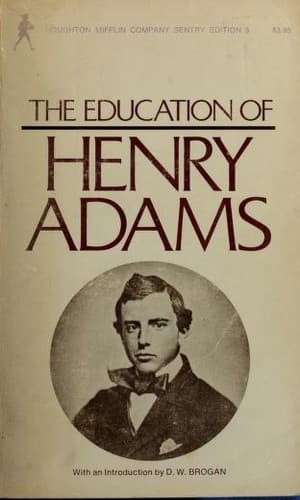
Adams, Henry, 1838-1918; Historians -- United States -- Biography
Seward was still Secretary of State. Hardly yet an old man,
though showing marks of time and violence, Mr. Seward seemed little
changed in these eight years. He was the same--with a difference.
Perhaps he--unlike Henry Adams--had at last got an education, and all
he wanted. Perhaps he had resigned himself to doing without it.
Whatever the reason, although his manner was as roughly kind as ever,
and his talk as free, he appeared to have closed his account with the
public; he no longer seemed to care; he asked nothing, gave nothing,
and invited no support; he talked little of himself or of others, and
waited only for his discharge. Adams was well pleased to be near him in
these last days of his power and fame, and went much to his house in
the evenings when he was sure to be at his whist. At last, as the end
drew near, wanting to feel that the great man--the only chief he ever
served even as a volunteer--recognized some personal relation, he asked
Mr. Seward to dine with him one evening in his rooms, and play his game
of whist there, as he did every night in his own house. Mr. Seward came
and had his whist, and Adams remembered his rough parting speech: "A
very sensible entertainment!" It was the only favor he ever asked of
Mr. Seward, and the only one he ever accepted.
Thus, as a teacher of wisdom, after twenty years of example,
Governor Seward passed out of one's life, and Adams lost what should
have been his firmest ally; but in truth the State Department had
ceased to be the centre of his interest, and the Treasury had taken its
place. The Secretary of the Treasury was a man new to politics--Hugh
McCulloch--not a person of much importance in the eyes of practical
politicians such as young members of the press meant themselves to
become, but they all liked Mr. McCulloch, though they thought him a
stop-gap rather than a force. Had they known what sort of forces the
Treasury was to offer them for support in the generation to come, they
might have reflected a long while on their estimate of McCulloch. Adams
was fated to watch the flittings of many more Secretaries than he ever
cared to know, and he rather came back in the end to the idea that
McCulloch was the best of them, although he seemed to represent
everything that one liked least. He was no politician, he had no party,
and no power. He was not fashionable or decorative. He was a banker,
and towards bankers Adams felt the narrow prejudice which the serf
feels to his overseer; for he knew he must obey, and he knew that the
helpless showed only their helplessness when they tempered obedience by
mockery. The world, after 1865, became a bankers' world, and no banker
would ever trust one who had deserted State Street, and had gone to
Washington with purposes of doubtful credit, or of no credit at all,
for he could not have put up enough collateral to borrow five thousand
dollars of any bank in America. The banker never would trust him, and
he would never trust the banker.
Public-domain text, read in full here on John Shaqi.
Reviews
Reviews
No reviews yet
Be the first to share your thoughts on this work.
Elsewhere in the archive
Join the Discussion
Join the discussion
Sign in to leave a comment or review.
Sign InorCreate an account