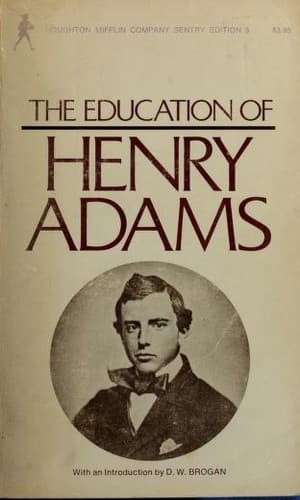
Adams, Henry, 1838-1918; Historians -- United States -- Biography
On the whole, the relation was the queerest that Henry Adams
ever kept up. He liked and admired Sumner, but thought his mind a
pathological study. At times he inclined to think that Sumner felt his
solitude, and, in the political wilderness, craved educated society;
but this hardly told the whole story. Sumner's mind had reached the
calm of water which receives and reflects images without absorbing
them; it contained nothing but itself. The images from without, the
objects mechanically perceived by the senses, existed by courtesy until
the mental surface was ruffled, but never became part of the thought.
Henry Adams roused no emotion; if he had roused a disagreeable one, he
would have ceased to exist. The mind would have mechanically rejected,
as it had mechanically admitted him. Not that Sumner was more
aggressively egoistic than other Senators--Conkling, for instance--but
that with him the disease had affected the whole mind; it was chronic
and absolute; while, with other Senators for the most part, it was
still acute.
Perhaps for this very reason, Sumner was the more valuable
acquaintance for a newspaper-man. Adams found him most useful; perhaps
quite the most useful of all these great authorities who were the
stock-in-trade of the newspaper business; the accumulated capital of a
Silurian age. A few months or years more, and they were gone. In 1868,
they were like the town itself, changing but not changed. La Fayette
Square was society. Within a few hundred yards of Mr. Clark Mills's
nursery monument to the equestrian seat of Andrew Jackson, one found
all one's acquaintance as well as hotels, banks, markets and national
government. Beyond the Square the country began. No rich or fashionable
stranger had yet discovered the town. No literary or scientific man, no
artist, no gentleman without office or employment, had ever lived
there. It was rural, and its society was primitive. Scarcely a person
in it had ever known life in a great city. Mr. Evarts, Mr. Sam Hooper,
of Boston, and perhaps one or two of the diplomatists had alone mixed
in that sort of world. The happy village was innocent of a club. The
one-horse tram on F Street to the Capitol was ample for traffic. Every
pleasant spring morning at the Pennsylvania Station, society met to bid
good-bye to its friends going off on the single express. The State
Department was lodged in an infant asylum far out on Fourteenth Street
while Mr. Mullett was constructing his architectural infant asylum next
the White House. The value of real estate had not increased since 1800,
and the pavements were more impassable than the mud. All this favored a
young man who had come to make a name. In four-and-twenty hours he
could know everybody; in two days everybody knew him.
Public-domain text, read in full here on John Shaqi.
Reviews
Reviews
No reviews yet
Be the first to share your thoughts on this work.
Elsewhere in the archive
Join the Discussion
Join the discussion
Sign in to leave a comment or review.
Sign InorCreate an account