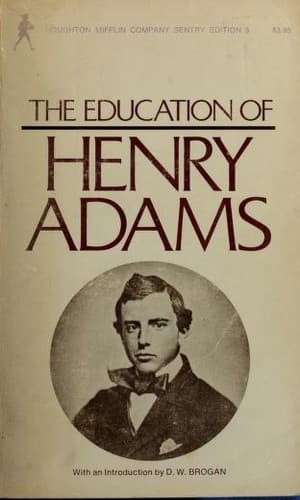
Adams, Henry, 1838-1918; Historians -- United States -- Biography
In waiting, he amused himself as he could. In the amusements of
Washington, education had no part, but the simplicity of the amusements
proved the simplicity of everything else, ambitions, interests,
thoughts, and knowledge. Proverbially Washington was a poor place for
education, and of course young diplomats avoided or disliked it, but,
as a rule, diplomats disliked every place except Paris, and the world
contained only one Paris. They abused London more violently than
Washington; they praised no post under the sun; and they were merely
describing three-fourths of their stations when they complained that
there were no theatres, no restaurants, no monde, no demi-monde, no
drives, no splendor, and, as Mme. de Struve used to say, no grandezza.
This was all true; Washington was a mere political camp, as transient
and temporary as a camp-meeting for religious revival, but the
diplomats had least reason to complain, since they were more sought for
there than they would ever be elsewhere. For young men Washington was
in one way paradise, since they were few, and greatly in demand. After
watching the abject unimportance of the young diplomat in London
society, Adams found himself a young duke in Washington. He had ten
years of youth to make up, and a ravenous appetite. Washington was the
easiest society he had ever seen, and even the Bostonian became simple,
good-natured, almost genial, in the softness of a Washington spring.
Society went on excellently well without houses, or carriages, or
jewels, or toilettes, or pavements, or shops, or grandezza of any sort;
and the market was excellent as well as cheap. One could not stay there
a month without loving the shabby town. Even the Washington girl, who
was neither rich nor well-dressed nor well-educated nor clever, had
singular charm, and used it. According to Mr. Adams the father, this
charm dated back as far as Monroe's administration, to his personal
knowledge.
Therefore, behind all the processes of political or financial
or newspaper training, the social side of Washington was to be taken
for granted as three-fourths of existence. Its details matter nothing.
Life ceased to be strenuous, and the victim thanked God for it.
Politics and reform became the detail, and waltzing the profession.
Adams was not alone. Senator Sumner had as private secretary a young
man named Moorfield Storey, who became a dangerous example of
frivolity. The new Attorney-General, E. R. Hoar, brought with him from
Concord a son, Sam Hoar, whose example rivalled that of Storey. Another
impenitent was named Dewey, a young naval officer. Adams came far down
in the list. He wished he had been higher. He could have spared a world
of superannuated history, science, or politics, to have reversed better
in waltzing.
Public-domain text, read in full here on John Shaqi.
Reviews
Reviews
No reviews yet
Be the first to share your thoughts on this work.
Elsewhere in the archive
Join the Discussion
Join the discussion
Sign in to leave a comment or review.
Sign InorCreate an account