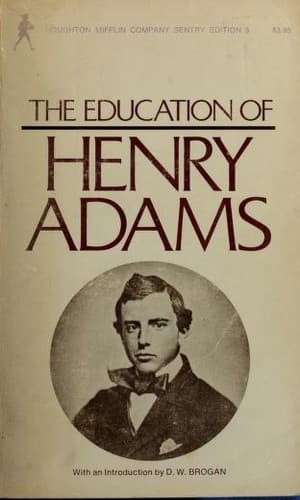
Adams, Henry, 1838-1918; Historians -- United States -- Biography
He had no adequate notion how little he knew, especially of
women, and Washington offered no standard of comparison. All were
profoundly ignorant together, and as indifferent as children to
education. No one needed knowledge. Washington was happier without
style. Certainly Adams was happier without it; happier than he had ever
been before; happier than any one in the harsh world of strenuousness
could dream of. This must be taken as background for such little
education as he gained; but the life belonged to the eighteenth
century, and in no way concerned education for the twentieth.
In such an atmosphere, one made no great pretence of hard work.
If the world wants hard work, the world must pay for it; and, if it
will not pay, it has no fault to find with the worker. Thus far, no one
had made a suggestion of pay for any work that Adams had done or could
do; if he worked at all, it was for social consideration, and social
pleasure was his pay. For this he was willing to go on working, as an
artist goes on painting when no one buys his pictures. Artists have
done it from the beginning of time, and will do it after time has
expired, since they cannot help themselves, and they find their return
in the pride of their social superiority as they feel it. Society
commonly abets them and encourages their attitude of contempt. The
society of Washington was too simple and Southern as yet, to feel
anarchistic longings, and it never read or saw what artists produced
elsewhere, but it good-naturedly abetted them when it had the chance,
and respected itself the more for the frailty. Adams found even the
Government at his service, and every one willing to answer his
questions. He worked, after a fashion; not very hard, but as much as
the Government would have required of him for nine hundred dollars a
year; and his work defied frivolity. He got more pleasure from writing
than the world ever got from reading him, for his work was not amusing,
nor was he. One must not try to amuse moneylenders or investors, and
this was the class to which he began by appealing. He gave three months
to an article on the finances of the United States, just then a subject
greatly needing treatment; and when he had finished it, he sent it to
London to his friend Henry Reeve, the ponderous editor of the Edinburgh
Review. Reeve probably thought it good; at all events, he said so; and
he printed it in April. Of course it was reprinted in America, but in
England such articles were still anonymous, and the author remained
unknown.
Public-domain text, read in full here on John Shaqi.
Reviews
Reviews
No reviews yet
Be the first to share your thoughts on this work.
Elsewhere in the archive
Join the Discussion
Join the discussion
Sign in to leave a comment or review.
Sign InorCreate an account