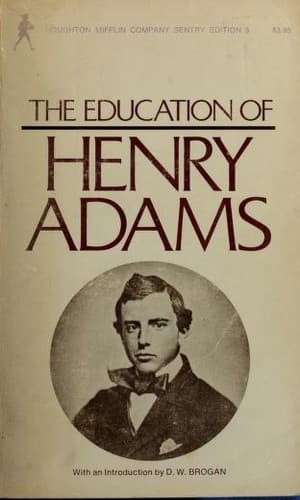
Adams, Henry, 1838-1918; Historians -- United States -- Biography
The first of these "Sessions" appeared in April, but it could
not be condensed into a single article, and had to be supplemented in
October by another which bore the title of "Civil Service Reform," and
was really a part of the same review. A good deal of authentic history
slipped into these papers. Whether any one except his press associates
ever read them, he never knew and never greatly cared. The difference
is slight, to the influence of an author, whether he is read by five
hundred readers, or by five hundred thousand; if he can select the five
hundred, he reaches the five hundred thousand. The fateful year 1870
was near at hand, which was to mark the close of the literary epoch,
when quarterlies gave way to monthlies; letter-press to illustration;
volumes to pages. The outburst was brilliant. Bret Harte led, and
Robert Louis Stevenson followed. Guy de Maupassant and Rudyard Kipling
brought up the rear, and dazzled the world. As usual, Adams found
himself fifty years behind his time, but a number of belated wanderers
kept him company, and they produced on each other the effect or
illusion of a public opinion. They straggled apart, at longer and
longer intervals, through the procession, but they were still within
hearing distance of each other. The drift was still superficially
conservative. Just as the Church spoke with apparent authority, or the
quarterlies laid down an apparent law, and no one could surely say
where the real authority, or the real law, lay. Science did not know.
Truths a priori held their own against truths surely relative.
According to Lowell, Right was forever on the scaffold, Wrong was
forever on the Throne; and most people still thought they believed it.
Adams was not the only relic of the eighteenth century, and he could
still depend on a certain number of listeners--mostly respectable, and
some rich.
Want of audience did not trouble him; he was well enough off in
that respect, and would have succeeded in all his calculations if this
had been his only hazard. Where he broke down was at a point where he
always suffered wreck and where nine adventurers out of ten make their
errors. One may be more or less certain of organized forces; one can
never be certain of men. He belonged to the eighteenth century, and the
eighteenth century upset all his plans. For the moment, America was
more eighteenth century than himself; it reverted to the stone age.
As education--of a certain sort--the story had probably a
certain value, though he could never see it. One seldom can see much
education in the buck of a broncho; even less in the kick of a mule.
The lesson it teaches is only that of getting out of the animal's way.
This was the lesson that Henry Adams had learned over and over again in
politics since 1860.
Public-domain text, read in full here on John Shaqi.
Reviews
Reviews
No reviews yet
Be the first to share your thoughts on this work.
Elsewhere in the archive
Join the Discussion
Join the discussion
Sign in to leave a comment or review.
Sign InorCreate an account