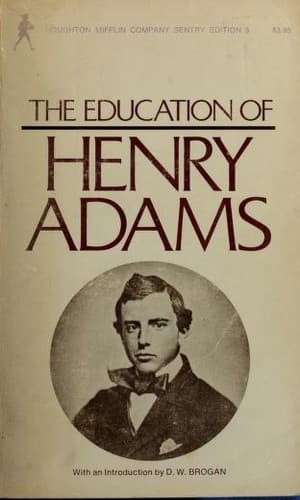
Adams, Henry, 1838-1918; Historians -- United States -- Biography
At least four-fifths of the American people--Adams among the
rest--had united in the election of General Grant to the Presidency,
and probably had been more or less affected in their choice by the
parallel they felt between Grant and Washington. Nothing could be more
obvious. Grant represented order. He was a great soldier, and the
soldier always represented order. He might be as partisan as he
pleased, but a general who had organized and commanded half a million
or a million men in the field, must know how to administer. Even
Washington, who was, in education and experience, a mere cave-dweller,
had known how to organize a government, and had found Jeffersons and
Hamiltons to organize his departments. The task of bringing the
Government back to regular practices, and of restoring moral and
mechanical order to administration, was not very difficult; it was
ready to do it itself, with a little encouragement. No doubt the
confusion, especially in the old slave States and in the currency, was
considerable, but, the general disposition was good, and every one had
echoed that famous phrase: "Let us have peace."
Adams was young and easily deceived, in spite of his diplomatic
adventures, but even at twice his age he could not see that this
reliance on Grant was unreasonable. Had Grant been a Congressman one
would have been on one's guard, for one knew the type. One never
expected from a Congressman more than good intentions and public
spirit. Newspaper-men as a rule had no great respect for the lower
House; Senators had less; and Cabinet officers had none at all. Indeed,
one day when Adams was pleading with a Cabinet officer for patience and
tact in dealing with Representatives, the Secretary impatiently broke
out: "You can't use tact with a Congressman! A Congressman is a hog!
You must take a stick and hit him on the snout!" Adams knew far too
little, compared with the Secretary, to contradict him, though he
thought the phrase somewhat harsh even as applied to the average
Congressman of 1869--he saw little or nothing of later ones--but he
knew a shorter way of silencing criticism. He had but to ask: "If a
Congressman is a hog, what is a Senator?" This innocent question, put
in a candid spirit, petrified any executive officer that ever sat a
week in his office. Even Adams admitted that Senators passed belief.
The comic side of their egotism partly disguised its extravagance, but
faction had gone so far under Andrew Johnson that at times the whole
Senate seemed to catch hysterics of nervous bucking without apparent
reason. Great leaders, like Sumner and Conkling, could not be
burlesqued; they were more grotesque than ridicule could make them;
even Grant, who rarely sparkled in epigram, became witty on their
account; but their egotism and factiousness were no laughing matter.
They did permanent and terrible mischief, as Garfield and Blaine, and
even McKinley and John Hay, were to feel. The most troublesome task of
Public-domain text, read in full here on John Shaqi.
Reviews
Reviews
No reviews yet
Be the first to share your thoughts on this work.
Elsewhere in the archive
Join the Discussion
Join the discussion
Sign in to leave a comment or review.
Sign InorCreate an account