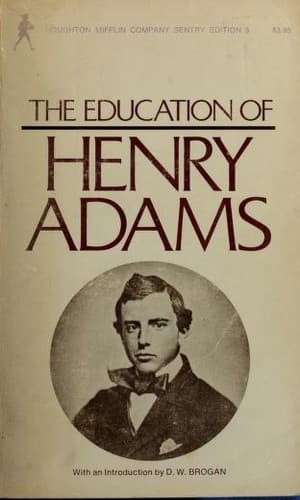
Adams, Henry, 1838-1918; Historians -- United States -- Biography
Between these great forces, where was the Administration and
how was one to support it? One must first find it, and even then it was
not easily caught. Grant's simplicity was more disconcerting than the
complexity of a Talleyrand. Mr. Fish afterwards told Adams, with the
rather grim humor he sometimes indulged in, that Grant took a dislike
to Motley because he parted his hair in the middle. Adams repeated the
story to Godkin, who made much play with it in the Nation, till it was
denied. Adams saw no reason why it should be denied. Grant had as good
a right to dislike the hair as the head, if the hair seemed to him a
part of it. Very shrewd men have formed very sound judgments on less
material than hair--on clothes, for example, according to Mr. Carlyle,
or on a pen, according to Cardinal de Retz--and nine men in ten could
hardly give as good a reason as hair for their likes or dislikes. In
truth, Grant disliked Motley at sight, because they had nothing in
common; and for the same reason he disliked Sumner. For the same reason
he would be sure to dislike Adams if Adams gave him a chance. Even Fish
could not be quite sure of Grant, except for the powerful effect which
wealth had, or appeared to have, on Grant's imagination.
The quarrel that lowered over the State Department did not
break in storm till July, 1870, after Adams had vanished, but another
quarrel, almost as fatal to Adams as that between Fish and Sumner,
worried him even more. Of all members of the Cabinet, the one whom he
had most personal interest in cultivating was Attorney General Hoar.
The Legal Tender decision, which had been the first stumbling-block to
Adams at Washington, grew in interest till it threatened to become
something more serious than a block; it fell on one's head like a
plaster ceiling, and could not be escaped. The impending battle between
Fish and Sumner was nothing like so serious as the outbreak between
Hoar and Chief Justice Chase. Adams had come to Washington hoping to
support the Executive in a policy of breaking down the Senate, but he
never dreamed that he would be required to help in breaking down the
Supreme Court. Although, step by step, he had been driven, like the
rest of the world, to admit that American society had outgrown most of
its institutions, he still clung to the Supreme Court, much as a
churchman clings to his bishops, because they are his only symbol of
unity; his last rag of Right. Between the Executive and the
Legislature, citizens could have no Rights; they were at the mercy of
Power. They had created the Court to protect them from unlimited Power,
and it was little enough protection at best. Adams wanted to save the
independence of the Court at least for his lifetime, and could not
conceive that the Executive should wish to overthrow it.
Public-domain text, read in full here on John Shaqi.
Reviews
Reviews
No reviews yet
Be the first to share your thoughts on this work.
Elsewhere in the archive
Join the Discussion
Join the discussion
Sign in to leave a comment or review.
Sign InorCreate an account