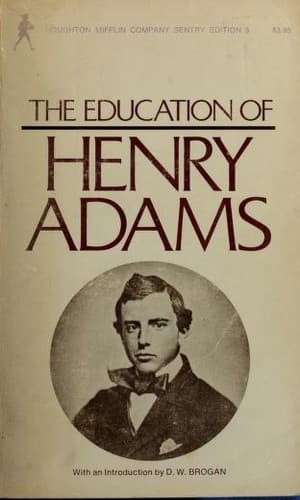
Adams, Henry, 1838-1918; Historians -- United States -- Biography
Frank Walker shared this feeling, and, by way of helping the
Court, he had promised Adams for the North American Review an article
on the history of the Legal Tender Act, founded on a volume just then
published by Spaulding, the putative father of the legal-tender clause
in 1861. Secretary Jacob D. Cox, who alone sympathized with reform,
saved from Boutwell's decree of banishment such reformers as he could
find place for, and he saved Walker for a time by giving him the Census
of 1870. Walker was obliged to abandon his article for the North
American in order to devote himself to the Census. He gave Adams his
notes, and Adams completed the article.
He had not toiled in vain over the Bank of England Restriction.
He knew enough about Legal Tender to leave it alone. If the banks and
bankers wanted fiat money, fiat money was good enough for a
newspaper-man; and if they changed about and wanted "intrinsic" value,
gold and silver came equally welcome to a writer who was paid half the
wages of an ordinary mechanic. He had no notion of attacking or
defending Legal Tender; his object was to defend the Chief Justice and
the Court. Walker argued that, whatever might afterwards have been the
necessity for legal tender, there was no necessity for it at the time
the Act was passed. With the help of the Chief Justice's recollections,
Adams completed the article, which appeared in the April number of the
North American. Its ferocity was Walker's, for Adams never cared to
abandon the knife for the hatchet, but Walker reeked of the army and
the Springfield Republican, and his energy ran away with Adams's
restraint. The unfortunate Spaulding complained loudly of this
treatment, not without justice, but the article itself had serious
historical value, for Walker demolished every shred of Spaulding's
contention that legal tender was necessary at the time; and the Chief
Justice told his part of the story with conviction. The Chief Justice
seemed to be pleased. The Attorney General, pleased or not, made no
sign. The article had enough historical interest to induce Adams to
reprint it in a volume of Essays twenty years afterwards; but its
historical value was not its point in education. The point was that, in
spite of the best intentions, the plainest self-interest, and the
strongest wish to escape further trouble, the article threw Adams into
opposition. Judge Hoar, like Boutwell, was implacable.
Public-domain text, read in full here on John Shaqi.
Reviews
Reviews
No reviews yet
Be the first to share your thoughts on this work.
Elsewhere in the archive
Join the Discussion
Join the discussion
Sign in to leave a comment or review.
Sign InorCreate an account