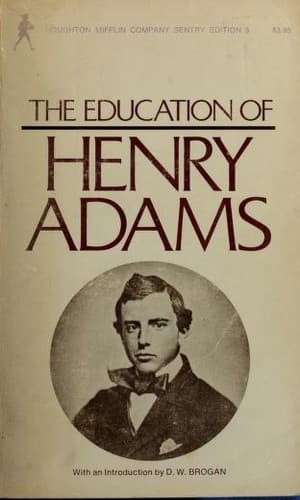
Adams, Henry, 1838-1918; Historians -- United States -- Biography
One found one's self in a singular frame of mind--more
eighteenth-century than ever--almost rococo--and unable to catch
anywhere the cog-wheels of evolution. Experience ceased to educate.
London taught less freely than of old. That one bad style was leading
to another--that the older men were more amusing than the younger--that
Lord Houghton's breakfast-table showed gaps hard to fill--that there
were fewer men one wanted to meet--these, and a hundred more such
remarks, helped little towards a quicker and more intelligent activity.
For English reforms Adams cared nothing. The reforms were themselves
mediaeval. The Education Bill of his friend W. E. Forster seemed to him
a guaranty against all education he had use for. He resented change. He
would have kept the Pope in the Vatican and the Queen at Windsor Castle
as historical monuments. He did not care to Americanize Europe. The
Bastille or the Ghetto was a curiosity worth a great deal of money, if
preserved; and so was a Bishop; so was Napoleon III. The tourist was
the great conservative who hated novelty and adored dirt. Adams came
back to London without a thought of revolution or restlessness or
reform. He wanted amusement, quiet, and gaiety.
Had he not been born in 1838 under the shadow of Boston State
House, and been brought up in the Early Victorian epoch, he would have
cast off his old skin, and made his court to Marlborough House, in
partnership with the American woman and the Jew banker. Common-sense
dictated it; but Adams and his friends were unfashionable by some law
of Anglo-Saxon custom--some innate atrophy of mind. Figuring himself as
already a man of action, and rather far up towards the front, he had no
idea of making a new effort or catching up with a new world. He saw
nothing ahead of him. The world was never more calm. He wanted to talk
with Ministers about the Alabama Claims, because he looked on the
Claims as his own special creation, discussed between him and his
father long before they had been discussed by Government; he wanted to
make notes for his next year's articles; but he had not a thought that,
within three months, his world was to be upset, and he under it. Frank
Palgrave came one day, more contentious, contemptuous, and paradoxical
than ever, because Napoleon III seemed to be threatening war with
Germany. Palgrave said that "Germany would beat France into scraps" if
there was war. Adams thought not. The chances were always against
catastrophes. No one else expected great changes in Europe. Palgrave
was always extreme; his language was incautious--violent!
Public-domain text, read in full here on John Shaqi.
Reviews
Reviews
No reviews yet
Be the first to share your thoughts on this work.
Elsewhere in the archive
Join the Discussion
Join the discussion
Sign in to leave a comment or review.
Sign InorCreate an account