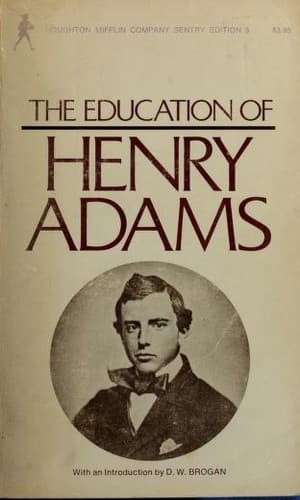
Adams, Henry, 1838-1918; Historians -- United States -- Biography
In this year of all years, Adams lost sight of education.
Things began smoothly, and London glowed with the pleasant sense of
familiarity and dinners. He sniffed with voluptuous delight the
coal-smoke of Cheapside and revelled in the architecture of Oxford
Street. May Fair never shone so fair to Arthur Pendennis as it did to
the returned American. The country never smiled its velvet smile of
trained and easy hostess as it did when he was so lucky as to be asked
on a country visit. He loved it all--everything--had always loved it!
He felt almost attached to the Royal Exchange. He thought he owned the
St. James's Club. He patronized the Legation.
The first shock came lightly, as though Nature were playing
tricks on her spoiled child, though she had thus far not exerted
herself to spoil him. Reeve refused the Gold Conspiracy. Adams had
become used to the idea that he was free of the Quarterlies, and that
his writing would be printed of course; but he was stunned by the
reason of refusal. Reeve said it would bring half-a-dozen libel suits
on him. One knew that the power of Erie was almost as great in England
as in America, but one was hardly prepared to find it controlling the
Quarterlies. The English press professed to be shocked in 1870 by the
Erie scandal, as it had professed in 1860 to be shocked by the scandal
of slavery, but when invited to support those who were trying to abate
these scandals, the English press said it was afraid. To Adams, Reeve's
refusal seemed portentous. He and his brother and the North American
Review were running greater risks every day, and no one thought of
fear. That a notorious story, taken bodily from an official document,
should scare the Edinburgh Review into silence for fear of Jay Gould
and Jim Fisk, passed even Adams's experience of English eccentricity,
though it was large.
He gladly set down Reeve's refusal of the Gold Conspiracy to
respectability and editorial law, but when he sent the manuscript on to
the Quarterly, the editor of the Quarterly also refused it. The
literary standard of the two Quarterlies was not so high as to suggest
that the article was illiterate beyond the power of an active and
willing editor to redeem it. Adams had no choice but to realize that he
had to deal in 1870 with the same old English character of 1860, and
the same inability in himself to understand it. As usual, when an ally
was needed, the American was driven into the arms of the radicals.
Respectability, everywhere and always, turned its back the moment one
asked to do it a favor. Called suddenly away from England, he
despatched the article, at the last moment, to the Westminster Review
and heard no more about it for nearly six months.
Public-domain text, read in full here on John Shaqi.
Reviews
Reviews
No reviews yet
Be the first to share your thoughts on this work.
Elsewhere in the archive
Join the Discussion
Join the discussion
Sign in to leave a comment or review.
Sign InorCreate an account