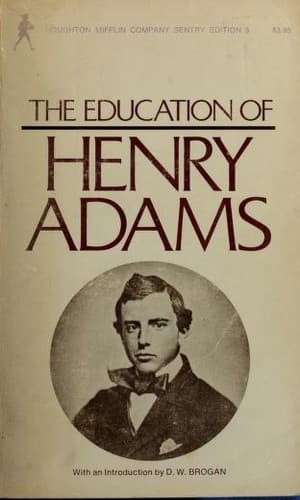
Adams, Henry, 1838-1918; Historians -- United States -- Biography
On July 4, all Europe had been in peace; on July 14, Europe was
in full chaos of war. One felt helpless and ignorant, but one might
have been king or kaiser without feeling stronger to deal with the
chaos. Mr. Gladstone was as much astounded as Adams; the Emperor
Napoleon was nearly as stupefied as either, and Bismarck: himself
hardly knew how he did it. As education, the out-break of the war was
wholly lost on a man dealing with death hand-to-hand, who could not
throw it aside to look at it across the Rhine. Only when he got up to
Paris, he began to feel the approach of catastrophe. Providence set up
no affiches to announce the tragedy. Under one's eyes France cut
herself adrift, and floated off, on an unknown stream, towards a less
known ocean. Standing on the curb of the Boulevard, one could see as
much as though one stood by the side of the Emperor or in command of an
army corps. The effect was lurid. The public seemed to look on the war,
as it had looked on the wars of Louis XIV and Francis I, as a branch of
decorative art. The French, like true artists, always regarded war as
one of the fine arts. Louis XIV practiced it; Napoleon I perfected it;
and Napoleon III had till then pursued it in the same spirit with
singular success. In Paris, in July, 1870, the war was brought out like
an opera of Meyerbeer. One felt one's self a supernumerary hired to
fill the scene. Every evening at the theatre the comedy was interrupted
by order, and one stood up by order, to join in singing the
Marseillaise to order. For nearly twenty years one had been forbidden
to sing the Marseillaise under any circumstances, but at last regiment
after regiment marched through the streets shouting "Marchons!" while
the bystanders cared not enough to join. Patriotism seemed to have been
brought out of the Government stores, and distributed by grammes per
capita. One had seen one's own people dragged unwillingly into a war,
and had watched one's own regiments march to the front without sign of
enthusiasm; on the contrary, most serious, anxious, and conscious of
the whole weight of the crisis; but in Paris every one conspired to
ignore the crisis, which every one felt at hand. Here was education for
the million, but the lesson was intricate. Superficially Napoleon and
his Ministers and marshals were playing a game against Thiers and
Gambetta. A bystander knew almost as little as they did about the
result. How could Adams prophesy that in another year or two, when he
spoke of his Paris and its tastes, people would smile at his dotage?
Public-domain text, read in full here on John Shaqi.
Reviews
Reviews
No reviews yet
Be the first to share your thoughts on this work.
Elsewhere in the archive
Join the Discussion
Join the discussion
Sign in to leave a comment or review.
Sign InorCreate an account