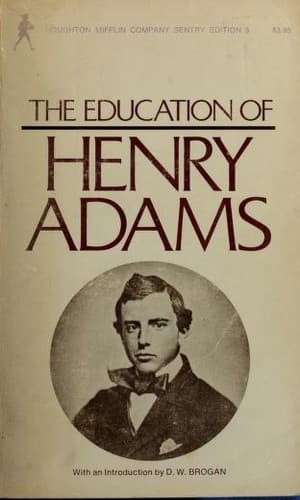
Adams, Henry, 1838-1918; Historians -- United States -- Biography
Had this been all, life might have gone on very happily as
before, but the ways of America to a young person of literary and
political tastes were such as the so-called evolution of civilized man
had not before evolved. No sooner had Adams made at Washington what he
modestly hoped was a sufficient success, than his whole family set on
him to drag him away. For the first time since 1861 his father
interposed; his mother entreated; and his brother Charles argued and
urged that he should come to Harvard College. Charles had views of
further joint operations in a new field. He said that Henry had done at
Washington all he could possibly do; that his position there wanted
solidity; that he was, after all, an adventurer; that a few years in
Cambridge would give him personal weight; that his chief function was
not to be that of teacher, but that of editing the North American
Review which was to be coupled with the professorship, and would lead
to the daily press. In short, that he needed the university more than
the university needed him.
Henry knew the university well enough to know that the
department of history was controlled by one of the most astute and
ideal administrators in the world--Professor Gurney--and that it was
Gurney who had established the new professorship, and had cast his net
over Adams to carry the double load of mediaeval history and the
Review. He could see no relation whatever between himself and a
professorship. He sought education; he did not sell it. He knew no
history; he knew only a few historians; his ignorance was mischievous
because it was literary, accidental, indifferent. On the other hand he
knew Gurney, and felt much influenced by his advice. One cannot take
one's self quite seriously in such matters; it could not much affect
the sum of solar energies whether one went on dancing with girls in
Washington, or began talking to boys at Cambridge. The good people who
thought it did matter had a sort of right to guide. One could not
reject their advice; still less disregard their wishes.
The sum of the matter was that Henry went out to Cambridge and
had a few words with President Eliot which seemed to him almost as
American as the talk about diplomacy with his father ten years before.
"But, Mr. President," urged Adams, "I know nothing about Mediaeval
History." With the courteous manner and bland smile so familiar for the
next generation of Americans Mr. Eliot mildly but firmly replied, "If
you will point out to me any one who knows more, Mr. Adams, I will
appoint him." The answer was neither logical nor convincing, but Adams
could not meet it without overstepping his privileges. He could not say
that, under the circumstances, the appointment of any professor at all
seemed to him unnecessary.
Public-domain text, read in full here on John Shaqi.
Reviews
Reviews
No reviews yet
Be the first to share your thoughts on this work.
Elsewhere in the archive
Join the Discussion
Join the discussion
Sign in to leave a comment or review.
Sign InorCreate an account