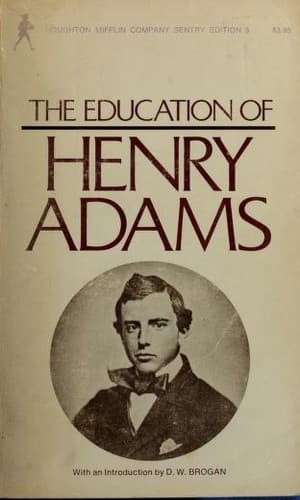
Adams, Henry, 1838-1918; Historians -- United States -- Biography
So, at twenty-four hours' notice, he broke his life in halves
again in order to begin a new education, on lines he had not chosen, in
subjects for which he cared less than nothing; in a place he did not
love, and before a future which repelled. Thousands of men have to do
the same thing, but his case was peculiar because he had no need to do
it. He did it because his best and wisest friends urged it, and he
never could make up his mind whether they were right or not. To him
this kind of education was always false. For himself he had no doubts.
He thought it a mistake; but his opinion did not prove that it was one,
since, in all probability, whatever he did would be more or less a
mistake. He had reached cross-roads of education which all led astray.
What he could gain at Harvard College he did not know, but in any case
it was nothing he wanted. What he lost at Washington he could partly
see, but in any case it was not fortune. Grant's administration wrecked
men by thousands, but profited few. Perhaps Mr. Fish was the solitary
exception. One might search the whole list of Congress, Judiciary, and
Executive during the twenty-five years 1870 to 1895, and find little
but damaged reputation. The period was poor in purpose and barren in
results.
Henry Adams, if not the rose, lived as near it as any
politician, and knew, more or less, all the men in any way prominent at
Washington, or knew all about them. Among them, in his opinion, the
best equipped, the most active-minded, and most industrious was Abram
Hewitt, who sat in Congress for a dozen years, between 1874 and 1886,
sometimes leading the House and always wielding influence second to
none. With nobody did Adams form closer or longer relations than with
Mr. Hewitt, whom he regarded as the most useful public man in
Washington; and he was the more struck by Hewitt's saying, at the end
of his laborious career as legislator, that he left behind him no
permanent result except the Act consolidating the Surveys. Adams knew
no other man who had done so much, unless Mr. Sherman's legislation is
accepted as an instance of success. Hewitt's nearest rival would
probably have been Senator Pendleton who stood father to civil service
reform in 1882, an attempt to correct a vice that should never have
been allowed to be born. These were the men who succeeded.
The press stood in much the same light. No editor, no political
writer, and no public administrator achieved enough good reputation to
preserve his memory for twenty years. A number of them achieved bad
reputations, or damaged good ones that had been gained in the Civil
War. On the whole, even for Senators, diplomats, and Cabinet officers,
the period was wearisome and stale.
Public-domain text, read in full here on John Shaqi.
Reviews
Reviews
No reviews yet
Be the first to share your thoughts on this work.
Elsewhere in the archive
Join the Discussion
Join the discussion
Sign in to leave a comment or review.
Sign InorCreate an account