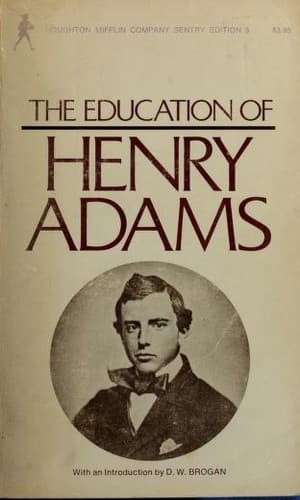
Adams, Henry, 1838-1918; Historians -- United States -- Biography
What was the use of training an active mind to waste its
energy? The experiments might in time train Adams as a professor, but
this result was still less to his taste. He wanted to help the boys to
a career, but not one of his many devices to stimulate the intellectual
reaction of the student's mind satisfied either him or the students.
For himself he was clear that the fault lay in the system, which could
lead only to inertia. Such little knowledge of himself as he possessed
warranted him in affirming that his mind required conflict,
competition, contradiction even more than that of the student. He too
wanted a rank-list to set his name upon. His reform of the system would
have begun in the lecture-room at his own desk. He would have seated a
rival assistant professor opposite him, whose business should be
strictly limited to expressing opposite views. Nothing short of this
would ever interest either the professor or the student; but of all
university freaks, no irregularity shocked the intellectual atmosphere
so much as contradiction or competition between teachers. In that
respect the thirteenth-century university system was worth the whole
teaching of the modern school.
All his pretty efforts to create conflicts of thought among his
students failed for want of system. None met the needs of instruction.
In spite of President Eliot's reforms and his steady, generous, liberal
support, the system remained costly, clumsy and futile. The
university--as far as it was represented by Henry Adams--produced at
great waste of time and money results not worth reaching.
He made use of his lost two years of German schooling to
inflict their results on his students, and by a happy chance he was in
the full tide of fashion. The Germans were crowning their new emperor
at Versailles, and surrounding his head with a halo of Pepins and
Merwigs, Othos and Barbarossas. James Bryce had even discovered the
Holy Roman Empire. Germany was never so powerful, and the Assistant
Professor of History had nothing else as his stock in trade. He imposed
Germany on his scholars with a heavy hand. He was rejoiced; but he
sometimes doubted whether they should be grateful. On the whole, he was
content neither with what he had taught nor with the way he had taught
it. The seven years he passed in teaching seemed to him lost.
Public-domain text, read in full here on John Shaqi.
Reviews
Reviews
No reviews yet
Be the first to share your thoughts on this work.
Elsewhere in the archive
Join the Discussion
Join the discussion
Sign in to leave a comment or review.
Sign InorCreate an account