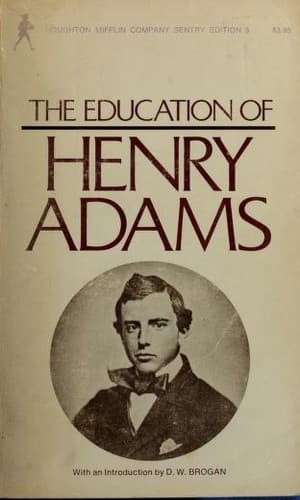
Adams, Henry, 1838-1918; Historians -- United States -- Biography
Adams thought that, as no one seemed to care what he did, he
would try to cultivate this tenth mind, though necessarily at the
expense of the other nine. He frankly acted on the rule that a teacher,
who knew nothing of his subject, should not pretend to teach his
scholars what he did not know, but should join them in trying to find
the best way of learning it. The rather pretentious name of historical
method was sometimes given to this process of instruction, but the name
smacked of German pedagogy, and a young professor who respected neither
history nor method, and whose sole object of interest was his students'
minds, fell into trouble enough without adding to it a German parentage.
The task was doomed to failure for a reason which he could not
control. Nothing is easier than to teach historical method, but, when
learned, it has little use. History is a tangled skein that one may
take up at any point, and break when one has unravelled enough; but
complexity precedes evolution. The Pteraspis grins horribly from the
closed entrance. One may not begin at the beginning, and one has but
the loosest relative truths to follow up. Adams found himself obliged
to force his material into some shape to which a method could be
applied. He could think only of law as subject; the Law School as end;
and he took, as victims of his experiment, half-a-dozen highly
intelligent young men who seemed willing to work. The course began with
the beginning, as far as the books showed a beginning in primitive man,
and came down through the Salic Franks to the Norman English. Since no
textbooks existed, the professor refused to profess, knowing no more
than his students, and the students read what they pleased and compared
their results. As pedagogy, nothing could be more triumphant. The boys
worked like rabbits, and dug holes all over the field of archaic
society; no difficulty stopped them; unknown languages yielded before
their attack, and customary law became familiar as the police court;
undoubtedly they learned, after a fashion, to chase an idea, like a
hare, through as dense a thicket of obscure facts as they were likely
to meet at the bar; but their teacher knew from his own experience that
his wonderful method led nowhere, and they would have to exert
themselves to get rid of it in the Law School even more than they
exerted themselves to acquire it in the college. Their science had no
system, and could have none, since its subject was merely antiquarian.
Try as hard as he might, the professor could not make it actual.
Public-domain text, read in full here on John Shaqi.
Reviews
Reviews
No reviews yet
Be the first to share your thoughts on this work.
Elsewhere in the archive
Join the Discussion
Join the discussion
Sign in to leave a comment or review.
Sign InorCreate an account