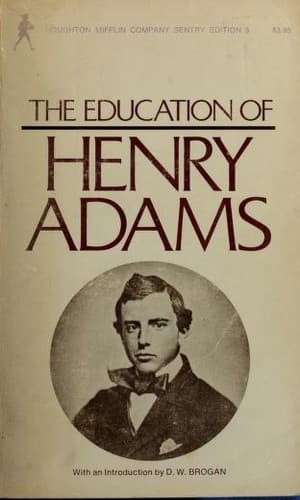
Adams, Henry, 1838-1918; Historians -- United States -- Biography
The only part of education that the professor thought a success
was the students. He found them excellent company. Cast more or less in
the same mould, without violent emotions or sentiment, and, except for
the veneer of American habits, ignorant of all that man had ever
thought or hoped, their minds burst open like flowers at the sunlight
of a suggestion. They were quick to respond; plastic to a mould; and
incapable of fatigue. Their faith in education was so full of pathos
that one dared not ask them what they thought they could do with
education when they got it. Adams did put the question to one of them,
and was surprised at the answer: "The degree of Harvard College is
worth money to me in Chicago." This reply upset his experience; for the
degree of Harvard College had been rather a drawback to a young man in
Boston and Washington. So far as it went, the answer was good, and
settled one's doubts. Adams knew no better, although he had given
twenty years to pursuing the same education, and was no nearer a result
than they. He still had to take for granted many things that they need
not--among the rest, that his teaching did them more good than harm. In
his own opinion the greatest good he could do them was to hold his
tongue. They needed much faith then; they were likely to need more if
they lived long.
He never knew whether his colleagues shared his doubts about
their own utility. Unlike himself, they knew more or less their
business. He could not tell his scholars that history glowed with
social virtue; the Professor of Chemistry cared not a chemical atom
whether society was virtuous or not. Adams could not pretend that
mediaeval society proved evolution; the Professor of Physics smiled at
evolution. Adams was glad to dwell on the virtues of the Church and the
triumphs of its art: the Professor of Political Economy had to treat
them as waste of force. They knew what they had to teach; he did not.
They might perhaps be frauds without knowing it; but he knew certainly
nothing else of himself. He could teach his students nothing; he was
only educating himself at their cost.
Education, like politics, is a rough affair, and every
instructor has to shut his eyes and hold his tongue as though he were a
priest. The students alone satisfied. They thought they gained
something. Perhaps they did, for even in America and in the twentieth
century, life could not be wholly industrial. Adams fervently hoped
that they might remain content; but supposing twenty years more to
pass, and they should turn on him as fiercely as he had turned on his
old instructors--what answer could he make? The college had pleaded
guilty, and tried to reform. He had pleaded guilty from the start, and
his reforms had failed before those of the college.
Public-domain text, read in full here on John Shaqi.
Reviews
Reviews
No reviews yet
Be the first to share your thoughts on this work.
Elsewhere in the archive
Join the Discussion
Join the discussion
Sign in to leave a comment or review.
Sign InorCreate an account