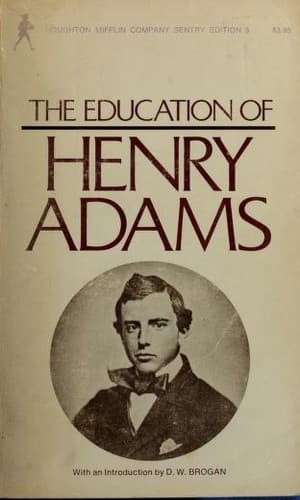
Adams, Henry, 1838-1918; Historians -- United States -- Biography
The lecture-room was futile enough, but the faculty-room was
worse. American society feared total wreck in the maelstrom of
political and corporate administration, but it could not look for help
to college dons. Adams knew, in that capacity, both Congressmen and
professors, and he preferred Congressmen. The same failure marked the
society of a college. Several score of the best-educated, most
agreeable, and personally the most sociable people in America united in
Cambridge to make a social desert that would have starved a polar bear.
The liveliest and most agreeable of men--James Russell Lowell, Francis
J. Child, Louis Agassiz, his son Alexander, Gurney, John Fiske, William
James and a dozen others, who would have made the joy of London or
Paris--tried their best to break out and be like other men in Cambridge
and Boston, but society called them professors, and professors they had
to be. While all these brilliant men were greedy for companionship, all
were famished for want of it. Society was a faculty-meeting without
business. The elements were there; but society cannot be made up of
elements--people who are expected to be silent unless they have
observations to make--and all the elements are bound to remain apart if
required to make observations.
Thus it turned out that of all his many educations, Adams
thought that of school-teacher the thinnest. Yet he was forced to admit
that the education of an editor, in some ways, was thinner still. The
editor had barely time to edit; he had none to write. If copy fell
short, he was obliged to scribble a book-review on the virtues of the
Anglo-Saxons or the vices of the Popes; for he knew more about Edward
the Confessor or Boniface VIII than he did about President Grant. For
seven years he wrote nothing; the Review lived on his brother Charles's
railway articles. The editor could help others, but could do nothing
for himself. As a writer, he was totally forgotten by the time he had
been an editor for twelve months. As editor he could find no writer to
take his place for politics and affairs of current concern. The Review
became chiefly historical. Russell Lowell and Frank Palgrave helped him
to keep it literary. The editor was a helpless drudge whose successes,
if he made any, belonged to his writers; but whose failures might
easily bankrupt himself. Such a Review may be made a sink of money with
captivating ease. The secrets of success as an editor were easily
learned; the highest was that of getting advertisements. Ten pages of
advertising made an editor a success; five marked him as a failure. The
merits or demerits of his literature had little to do with his results
except when they led to adversity.
Public-domain text, read in full here on John Shaqi.
Reviews
Reviews
No reviews yet
Be the first to share your thoughts on this work.
Elsewhere in the archive
Join the Discussion
Join the discussion
Sign in to leave a comment or review.
Sign InorCreate an account