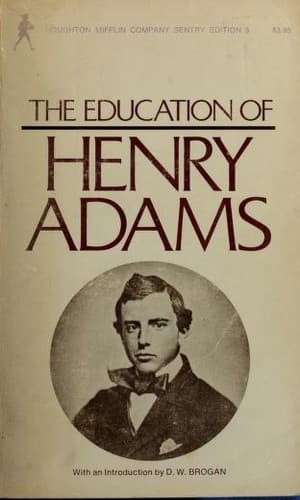
Adams, Henry, 1838-1918; Historians -- United States -- Biography
As a companion, King's charm was great, but this was not the quality
that so much attracted Adams, nor could he affect even distant rivalry
on this ground. Adams could never tell a story, chiefly because he
always forgot it; and he was never guilty of a witticism, unless by
accident. King and the Fortieth Parallel influenced him in a way far
more vital. The lines of their lives converged, but King had moulded
and directed his life logically, scientifically, as Adams thought
American life should be directed. He had given himself education all of
a piece, yet broad. Standing in the middle of his career, where their
paths at last came together, he could look back and look forward on a
straight line, with scientific knowledge for its base. Adams's life,
past or future, was a succession of violent breaks or waves, with no
base at all. King's abnormal energy had already won him great success.
None of his contemporaries had done so much, single-handed, or were
likely to leave so deep a trail. He had managed to induce Congress to
adopt almost its first modern act of legislation. He had organized, as
a civil--not military--measure, a Government Survey. He had paralleled
the Continental Railway in Geology; a feat as yet unequalled by other
governments which had as a rule no continents to survey. He was
creating one of the classic scientific works of the century. The
chances were great that he could, whenever he chose to quit the
Government service, take the pick of the gold and silver, copper or
coal, and build up his fortune as he pleased. Whatever prize he wanted
lay ready for him--scientific social, literary, political--and he knew
how to take them in turn. With ordinary luck he would die at eighty the
richest and most many-sided genius of his day.
So little egoistic he was that none of his friends felt envy of
his extraordinary superiority, but rather grovelled before it, so that
women were jealous of the power he had over men; but women were many
and Kings were one. The men worshipped not so much their friend, as the
ideal American they all wanted to be. The women were jealous because,
at heart, King had no faith in the American woman; he loved types more
robust.
The young men of the Fortieth Parallel had Californian
instincts; they were brothers of Bret Harte. They felt no leanings
towards the simple uniformities of Lyell and Darwin; they saw little
proof of slight and imperceptible changes; to them, catastrophe was the
law of change; they cared little for simplicity and much for
complexity; but it was the complexity of Nature, not of New York or
even of the Mississippi Valley. King loved paradox; he started them
like rabbits, and cared for them no longer, when caught or lost; but
they delighted Adams, for they helped, among other things, to persuade
him that history was more amusing than science. The only question left
open to doubt was their relative money value.
Public-domain text, read in full here on John Shaqi.
Reviews
Reviews
No reviews yet
Be the first to share your thoughts on this work.
Elsewhere in the archive
Join the Discussion
Join the discussion
Sign in to leave a comment or review.
Sign InorCreate an account