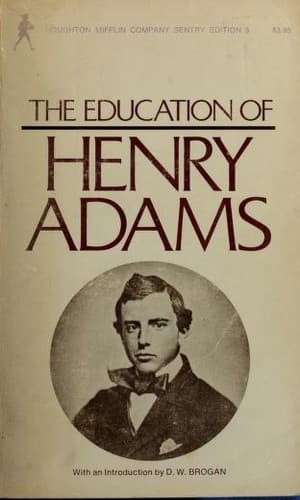
Adams, Henry, 1838-1918; Historians -- United States -- Biography
In Emmons's camp, far up in the Uintahs, these talks were
continued till the frosts became sharp in the mountains. History and
science spread out in personal horizons towards goals no longer far
away. No more education was possible for either man. Such as they were,
they had got to stand the chances of the world they lived in; and when
Adams started back to Cambridge, to take up again the humble tasks of
schoolmaster and editor he was harnessed to his cart. Education,
systematic or accidental, had done its worst. Henceforth, he went on,
submissive.
CHAPTER XXI
TWENTY YEARS AFTER (1892)
ONCE more! this is a story of education, not of adventure! It
is meant to help young men--or such as have intelligence enough to seek
help--but it is not meant to amuse them. What one did--or did not
do--with one's education, after getting it, need trouble the inquirer
in no way; it is a personal matter only which would confuse him.
Perhaps Henry Adams was not worth educating; most keen judges incline
to think that barely one man in a hundred owns a mind capable of
reacting to any purpose on the forces that surround him, and fully half
of these react wrongly. The object of education for that mind should be
the teaching itself how to react with vigor and economy. No doubt the
world at large will always lag so far behind the active mind as to make
a soft cushion of inertia to drop upon, as it did for Henry Adams; but
education should try to lessen the obstacles, diminish the friction,
invigorate the energy, and should train minds to react, not at
haphazard, but by choice, on the lines of force that attract their
world. What one knows is, in youth, of little moment; they know enough
who know how to learn. Throughout human history the waste of mind has
been appalling, and, as this story is meant to show, society has
conspired to promote it. No doubt the teacher is the worst criminal,
but the world stands behind him and drags the student from his course.
The moral is stentorian. Only the most energetic, the most highly
fitted, and the most favored have overcome the friction or the
viscosity of inertia, and these were compelled to waste three-fourths
of their energy in doing it.
Fit or unfit, Henry Adams stopped his own education in 1871,
and began to apply it for practical uses, like his neighbors. At the
end of twenty years, he found that he had finished, and could sum up
the result. He had no complaint to make against man or woman. They had
all treated him kindly; he had never met with ill-will, ill-temper, or
even ill-manners, or known a quarrel. He had never seen serious
dishonesty or ingratitude. He had found a readiness in the young to
respond to suggestion that seemed to him far beyond all he had reason
to expect. Considering the stock complaints against the world, he could
not understand why he had nothing to complain of.
Public-domain text, read in full here on John Shaqi.
Reviews
Reviews
No reviews yet
Be the first to share your thoughts on this work.
Elsewhere in the archive
Join the Discussion
Join the discussion
Sign in to leave a comment or review.
Sign InorCreate an account