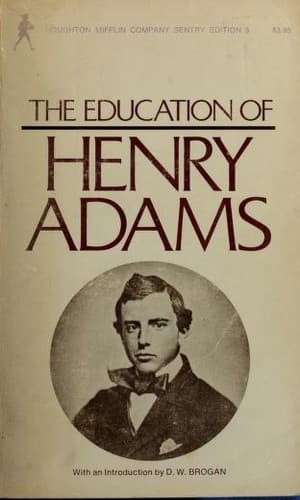
Adams, Henry, 1838-1918; Historians -- United States -- Biography
As had happened so often, he found himself in London when the
question of return imposed its verdict on him after much fruitless
effort to rest elsewhere. The time was the month of January, 1892; he
was alone, in hospital, in the gloom of midwinter. He was close on his
fifty-fourth birthday, and Pall Mall had forgotten him as completely as
it had forgotten his elders. He had not seen London for a dozen years,
and was rather amused to have only a bed for a world and a familiar
black fog for horizon. The coal-fire smelt homelike; the fog had a
fruity taste of youth; anything was better than being turned out into
the wastes of Wigmore Street. He could always amuse himself by living
over his youth, and driving once more down Oxford Street in 1858, with
life before him to imagine far less amusing than it had turned out to
be.
The future attracted him less. Lying there for a week he
reflected on what he could do next. He had just come up from the South
Seas with John La Farge, who had reluctantly crawled away towards New
York to resume the grinding routine of studio-work at an age when life
runs low. Adams would rather, as choice, have gone back to the east, if
it were only to sleep forever in the trade-winds under the southern
stars, wandering over the dark purple ocean, with its purple sense of
solitude and void. Not that he liked the sensation, but that it was the
most unearthly he had felt. He had not yet happened on Rudyard
Kipling's "Mandalay," but he knew the poetry before he knew the poem,
like millions of wanderers, who have perhaps alone felt the world
exactly as it is. Nothing attracted him less than the idea of beginning
a new education. The old one had been poor enough; any new one could
only add to its faults. Life had been cut in halves, and the old half
had passed away, education and all, leaving no stock to graft on.
The new world he faced in Paris and London seemed to him
fantastic. Willing to admit it real in the sense of having some kind of
existence outside his own mind, he could not admit it reasonable. In
Paris, his heart sank to mere pulp before the dismal ballets at the
Grand Opera and the eternal vaudeville at the old Palais Royal; but,
except for them, his own Paris of the Second Empire was as extinct as
that of the first Napoleon. At the galleries and exhibitions, he was
racked by the effort of art to be original, and when one day, after
much reflection, John La Farge asked whether there might not still be
room for something simple in art, Adams shook his head. As he saw the
world, it was no longer simple and could not express itself simply. It
should express what it was; and this was something that neither Adams
nor La Farge understood.
Public-domain text, read in full here on John Shaqi.
Reviews
Reviews
No reviews yet
Be the first to share your thoughts on this work.
Elsewhere in the archive
Join the Discussion
Join the discussion
Sign in to leave a comment or review.
Sign InorCreate an account