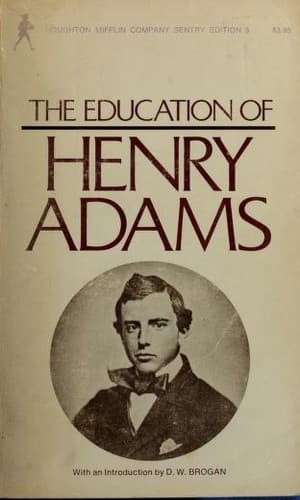
Adams, Henry, 1838-1918; Historians -- United States -- Biography
During these twenty years he had done as much work, in
quantity, as his neighbors wanted; more than they would ever stop to
look at, and more than his share. Merely in print, he thought
altogether ridiculous the number of volumes he counted on the shelves
of public libraries. He had no notion whether they served a useful
purpose; he had worked in the dark; but so had most of his friends,
even the artists, none of whom held any lofty opinion of their success
in raising the standards of society, or felt profound respect for the
methods or manners of their time, at home or abroad, but all of whom
had tried, in a way, to hold the standard up. The effort had been, for
the older generation, exhausting, as one could see in the Hunts; but
the generation after 1870 made more figure, not in proportion to public
wealth or in the census, but in their own self-assertion. A fair number
of the men who were born in the thirties had won names--Phillips
Brooks; Bret Harte; Henry James; H. H. Richardson; John La Farge; and
the list might be made fairly long if it were worth while; but from
their school had sprung others, like Augustus St. Gaudens, McKim,
Stanford White, and scores born in the forties, who counted as force
even in the mental inertia of sixty or eighty million people. Among all
these Clarence King, John Hay, and Henry Adams had led modest
existences, trying to fill in the social gaps of a class which, as yet,
showed but thin ranks and little cohesion. The combination offered no
very glittering prizes, but they pursued it for twenty years with as
much patience and effort as though it led to fame or power, until, at
last, Henry Adams thought his own duties sufficiently performed and his
account with society settled. He had enjoyed his life amazingly, and
would not have exchanged it for any other that came in his way; he was,
or thought he was, perfectly satisfied with it; but for reasons that
had nothing to do with education, he was tired; his nervous energy ran
low; and, like a horse that wears out, he quitted the race-course, left
the stable, and sought pastures as far as possible from the old.
Education had ended in 1871; life was complete in 1890; the rest
mattered so little!
Public-domain text, read in full here on John Shaqi.
Reviews
Reviews
No reviews yet
Be the first to share your thoughts on this work.
Elsewhere in the archive
Join the Discussion
Join the discussion
Sign in to leave a comment or review.
Sign InorCreate an account