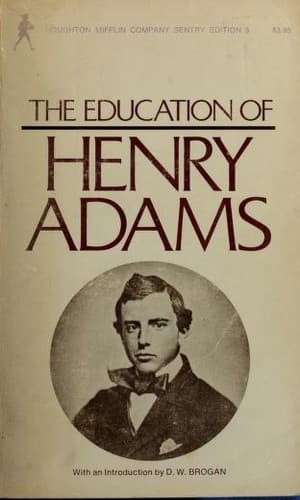
Adams, Henry, 1838-1918; Historians -- United States -- Biography
At last, on February 3, he drove, after a fashion, down the
Irish Channel, on board the Teutonic. He had not crossed the Atlantic
for a dozen years, and had never seen an ocean steamer of the new type.
He had seen nothing new of any sort, or much changed in France or
England. The railways made quicker time, but were no more comfortable.
The scale was the same. The Channel service was hardly improved since
1858, or so little as to make no impression. Europe seemed to have been
stationary for twenty years. To a man who had been stationary like
Europe, the Teutonic was a marvel. That he should be able to eat his
dinner through a week of howling winter gales was a miracle. That he
should have a deck stateroom, with fresh air, and read all night, if he
chose, by electric light, was matter for more wonder than life had yet
supplied, in its old forms. Wonder may be double--even treble. Adams's
wonder ran off into figures. As the Niagara was to the Teutonic--as
1860 was to 1890--so the Teutonic and 1890 must be to the next
term--and then? Apparently the question concerned only America. Western
Europe offered no such conundrum. There one might double scale and
speed indefinitely without passing bounds.
Fate was kind on that voyage. Rudyard Kipling, on his wedding
trip to America, thanks to the mediation of Henry James, dashed over
the passenger his exuberant fountain of gaiety and wit--as though
playing a garden hose on a thirsty and faded begonia. Kipling could
never know what peace of mind he gave, for he could hardly ever need it
himself so much; and yet, in the full delight of his endless fun and
variety, one felt the old conundrum repeat itself. Somehow, somewhere,
Kipling and the American were not one, but two, and could not be glued
together. The American felt that the defect, if defect it were, was in
himself; he had felt it when he was with Swinburne, and, again, with
Robert Louis Stevenson, even under the palms of Vailima; but he did not
carry self-abasement to the point of thinking himself singular.
Whatever the defect might be, it was American; it belonged to the type;
it lived in the blood. Whatever the quality might be that held him
apart, it was English; it lived also in the blood; one felt it little
if at all, with Celts, and one yearned reciprocally among Fiji
cannibals. Clarence King used to say that it was due to discord between
the wave-lengths of the man-atoms; but the theory offered difficulties
in measurement. Perhaps, after all, it was only that genius soars; but
this theory, too, had its dark corners. All through life, one had seen
the American on his literary knees to the European; and all through
many lives back for some two centuries, one had seen the European snub
or patronize the American; not always intentionally, but effectually.
It was in the nature of things. Kipling neither snubbed nor patronized;
he was all gaiety and good-nature; but he would have been first to feel
what one meant.
Public-domain text, read in full here on John Shaqi.
Reviews
Reviews
No reviews yet
Be the first to share your thoughts on this work.
Elsewhere in the archive
Join the Discussion
Join the discussion
Sign in to leave a comment or review.
Sign InorCreate an account