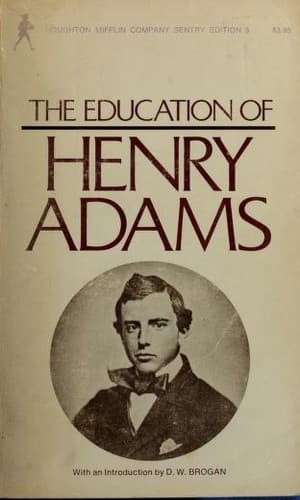
Adams, Henry, 1838-1918; Historians -- United States -- Biography
Genius has to pay itself that unwilling self-respect.
Towards the middle of February, 1892, Adams found himself again
in Washington. In Paris and London he had seen nothing to make a return
to life worth while; in Washington he saw plenty of reasons for staying
dead. Changes had taken place there; improvements had been made; with
time--much time--the city might become habitable according to some
fashionable standard; but all one's friends had died or disappeared
several times over, leaving one almost as strange as in Boston or
London. Slowly, a certain society had built itself up about the
Government; houses had been opened and there was much dining; much
calling; much leaving of cards; but a solitary man counted for less
than in 1868. Society seemed hardly more at home than he. Both
Executive and Congress held it aloof. No one in society seemed to have
the ear of anybody in Government. No one in Government knew any reason
for consulting any one in society. The world had ceased to be wholly
political, but politics had become less social. A survivor of the Civil
War--like George Bancroft, or John Hay--tried to keep footing, but
without brilliant success. They were free to say or do what they liked;
but no one took much notice of anything said or done.
A presidential election was to take place in November, and no
one showed much interest in the result. The two candidates were
singular persons, of whom it was the common saying that one of them had
no friends; the other, only enemies. Calvin Brice, who was at that time
altogether the wittiest and cleverest member of the Senate, was in the
habit of describing Mr. Cleveland in glowing terms and at great length,
as one of the loftiest natures and noblest characters of ancient or
modern time; "but," he concluded, "in future I prefer to look on at his
proceedings from the safe summit of some neighboring hill." The same
remark applied to Mr. Harrison. In this respect, they were the greatest
of Presidents, for, whatever harm they might do their enemies, was as
nothing when compared to the mortality they inflicted on their friends.
Men fled them as though they had the evil eye. To the American people,
the two candidates and the two parties were so evenly balanced that the
scales showed hardly a perceptible difference. Mr. Harrison was an
excellent President, a man of ability and force; perhaps the best
President the Republican Party had put forward since Lincoln's death;
yet, on the whole, Adams felt a shade of preference for President
Cleveland, not so much personally as because the Democrats represented
to him the last remnants of the eighteenth century; the survivors of
Hosea Biglow's Cornwallis; the sole remaining protestants against a
banker's Olympus which had become, for five-and-twenty years, more and
more despotic over Esop's frog-empire. One might no longer croak except
to vote for King Log, or--failing storks--for Grover Cleveland; and
Public-domain text, read in full here on John Shaqi.
Reviews
Reviews
No reviews yet
Be the first to share your thoughts on this work.
Elsewhere in the archive
Join the Discussion
Join the discussion
Sign in to leave a comment or review.
Sign InorCreate an account