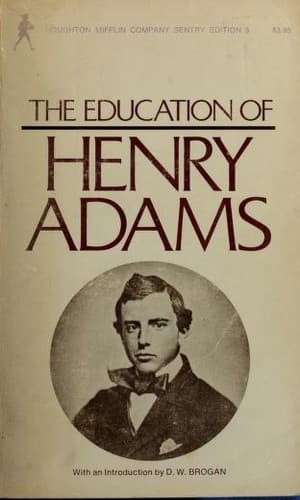
Adams, Henry, 1838-1918; Historians -- United States -- Biography
grandly courteous Southern phrase of Lamar: "Of course Mr. Adams knows
that anything in my power is at his service." A la disposicion de
Usted! The form must have been correct since it released both parties.
He was right; Mr. Adams did know all about it; a bow and a conventional
smile closed the subject forever, and every one felt flattered.
Such an intimate, promoted to power, was always lost. His
duties and cares absorbed him and affected his balance of mind. Unless
his friend served some political purpose, friendship was an effort. Men
who neither wrote for newspapers nor made campaign speeches, who rarely
subscribed to the campaign fund, and who entered the White House as
seldom as possible, placed themselves outside the sphere of usefulness,
and did so with entirely adequate knowledge of what they were doing.
They never expected the President to ask for their services, and saw no
reason why he should do so. As for Henry Adams, in fifty years that he
knew Washington, no one would have been more surprised than himself had
any President ever asked him to perform so much of a service as to
cross the square. Only Texan Congressmen imagined that the President
needed their services in some remote consulate after worrying him for
months to find one.
In Washington this law or custom is universally understood, and
no one's character necessarily suffered because he held no office. No
one took office unless he wanted it; and in turn the outsider was never
asked to do work or subscribe money. Adams saw no office that he
wanted, and he gravely thought that, from his point of view, in the
long run, he was likely to be a more useful citizen without office. He
could at least act as audience, and, in those days, a Washington
audience seldom filled even a small theatre. He felt quite well
satisfied to look on, and from time to time he thought he might risk a
criticism of the players; but though he found his own position regular,
he never quite understood that of John Hay. The Republican leaders
treated Hay as one of themselves; they asked his services and took his
money with a freedom that staggered even a hardened observer; but they
never needed him in equivalent office. In Washington Hay was the only
competent man in the party for diplomatic work. He corresponded in his
powers of usefulness exactly with Lord Granville in London, who had
been for forty years the saving grace of every Liberal administration
in turn. Had usefulness to the public service been ever a question, Hay
should have had a first-class mission under Hayes; should have been
placed in the Cabinet by Garfield, and should have been restored to it
by Harrison. These gentlemen were always using him; always invited his
services, and always took his money.
Public-domain text, read in full here on John Shaqi.
Reviews
Reviews
No reviews yet
Be the first to share your thoughts on this work.
Elsewhere in the archive
Join the Discussion
Join the discussion
Sign in to leave a comment or review.
Sign InorCreate an account