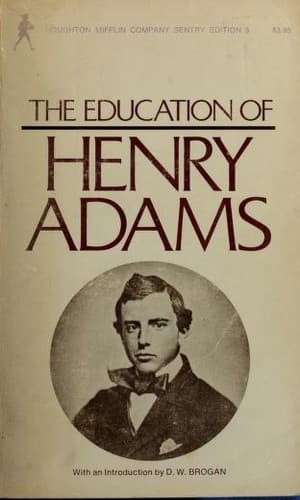
Adams, Henry, 1838-1918; Historians -- United States -- Biography
even then could not be sure where King Banker lurked behind. The costly
education in politics had led to political torpor. Every one did not
share it. Clarence King and John Hay were loyal Republicans who never
for a moment conceived that there could be merit in other ideals. With
King, the feeling was chiefly love of archaic races; sympathy with the
negro and Indian and corresponding dislike of their enemies; but with
Hay, party loyalty became a phase of being, a little like the loyalty
of a highly cultivated churchman to his Church. He saw all the failings
of the party, and still more keenly those of the partisans; but he
could not live outside. To Adams a Western Democrat or a Western
Republican, a city Democrat or a city Republican, a W. C. Whitney or a
J. G. Blaine, were actually the same man, as far as their usefulness to
the objects of King, Hay, or Adams was concerned. They graded
themselves as friends or enemies not as Republicans or Democrats. To
Hay, the difference was that of being respectable or not.
Since 1879, King, Hay, and Adams had been inseparable. Step by
step, they had gone on in the closest sympathy, rather shunning than
inviting public position, until, in 1892, none of them held any post at
all. With great effort, in Hayes's administration, all King's friends,
including Abram Hewitt and Carl Schurz, had carried the bill for
uniting the Surveys and had placed King at the head of the Bureau; but
King waited only to organize the service, and then resigned, in order
to seek his private fortune in the West. Hay, after serving as
Assistant Secretary of State under Secretary Evarts during a part of
Hayes's administration, then also insisted on going out, in order to
write with Nicolay the "Life" of Lincoln. Adams had held no office, and
when his friends asked the reason, he could not go into long
explanations, but preferred to answer simply that no President had ever
invited him to fill one. The reason was good, and was also conveniently
true, but left open an awkward doubt of his morals or capacity. Why had
no President ever cared to employ him? The question needed a volume of
intricate explanation. There never was a day when he would have refused
to perform any duty that the Government imposed on him, but the
American Government never to his knowledge imposed duties. The point
was never raised with regard to him, or to any one else. The Government
required candidates to offer; the business of the Executive began and
ended with the consent or refusal to confer. The social formula carried
this passive attitude a shade further. Any public man who may for years
have used some other man's house as his own, when promoted to a
position of patronage commonly feels himself obliged to inquire,
directly or indirectly, whether his friend wants anything; which is
equivalent to a civil act of divorce, since he feels awkward in the old
relation. The handsomest formula, in an impartial choice, was the
Public-domain text, read in full here on John Shaqi.
Reviews
Reviews
No reviews yet
Be the first to share your thoughts on this work.
Elsewhere in the archive
Join the Discussion
Join the discussion
Sign in to leave a comment or review.
Sign InorCreate an account