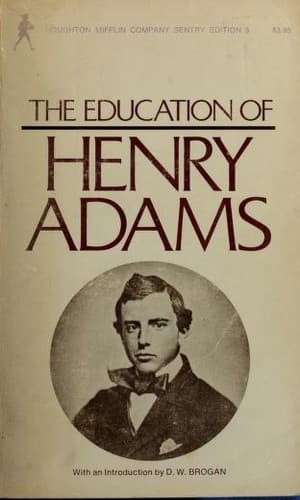
Adams, Henry, 1838-1918; Historians -- United States -- Biography
At all events, neither Hay nor King nor Adams had much to gain
by reelecting Mr. Harrison in 1892, or by defeating him, as far as he
was concerned; and as far as concerned Mr. Cleveland, they seemed to
have even less personal concern. The whole country, to outward
appearance, stood in much the same frame of mind. Everywhere was
slack-water. Hay himself was almost as languid and indifferent as
Adams. Neither had occupation. Both had finished their literary work.
The "Life" of Lincoln had been begun, completed, and published hand in
hand with the "History" of Jefferson and Madison, so that between them
they had written nearly all the American history there was to write.
The intermediate period needed intermediate treatment; the gap between
James Madison and Abraham Lincoln could not be judicially filled by
either of them. Both were heartily tired of the subject, and America
seemed as tired as they. What was worse, the redeeming energy of
Americans which had generally served as the resource of minds otherwise
vacant, the creation of new force, the application of expanding power,
showed signs of check. Even the year before, in 1891, far off in the
Pacific, one had met everywhere in the East a sort of stagnation--a
creeping paralysis--complaints of shipping and producers--that spread
throughout the whole southern hemisphere. Questions of exchange and
silver-production loomed large. Credit was shaken, and a change of
party government might shake it even in Washington. The matter did not
concern Adams, who had no credit, and was always richest when the rich
were poor; but it helped to dull the vibration of society.
However they studied it, the balance of profit and loss, on the
last twenty years, for the three friends, King, Hay, and Adams, was
exceedingly obscure in 1892. They had lost twenty years, but what had
they gained? They often discussed the question. Hay had a singular
faculty for remembering faces, and would break off suddenly the thread
of his talk, as he looked out of the window on La Fayette Square, to
notice an old corps commander or admiral of the Civil War, tottering
along to the club for his cards or his cocktail: "There is old Dash who
broke the rebel lines at Blankburg! Think of his having been a
thunderbolt of war!" Or what drew Adams's closer attention: "There goes
old Boutwell gambolling like the gambolling kid!" There they went! Men
who had swayed the course of empire as well as the course of Hay, King,
and Adams, less valued than the ephemeral Congressman behind them, who
could not have told whether the general was a Boutwell or Boutwell a
general. Theirs was the highest known success, and one asked what it
was worth to them. Apart from personal vanity, what would they sell it
for? Would any one of them, from President downwards, refuse ten
thousand a year in place of all the consideration he received from the
world on account of his success?
Public-domain text, read in full here on John Shaqi.
Reviews
Reviews
No reviews yet
Be the first to share your thoughts on this work.
Elsewhere in the archive
Join the Discussion
Join the discussion
Sign in to leave a comment or review.
Sign InorCreate an account