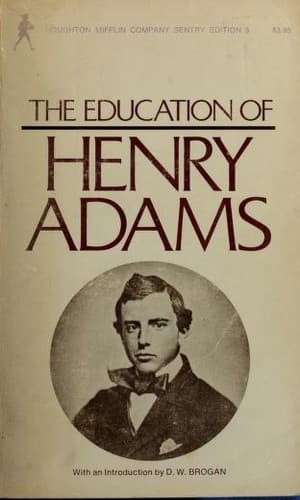
Adams, Henry, 1838-1918; Historians -- United States -- Biography
In February, 1893, Senator Cameron took his family to South
Carolina, where he had bought an old plantation at Coffin's Point on
St. Helena Island, and Adams, as one of the family, was taken, with the
rest, to open the new experience. From there he went on to Havana, and
came back to Coffin's Point to linger till near April. In May the
Senator took his family to Chicago to see the Exposition, and Adams
went with them. Early in June, all sailed for England together, and at
last, in the middle of July, all found themselves in Switzerland, at
Prangins, Chamounix, and Zermatt. On July 22 they drove across the
Furka Pass and went down by rail to Lucerne.
Months of close contact teach character, if character has
interest; and to Adams the Cameron type had keen interest, ever since
it had shipwrecked his career in the person of President Grant. Perhaps
it owed life to Scotch blood; perhaps to the blood of Adam and Eve, the
primitive strain of man; perhaps only to the blood of the cottager
working against the blood of the townsman; but whatever it was, one
liked it for its simplicity. The Pennsylvania mind, as minds go, was
not complex; it reasoned little and never talked; but in practical
matters it was the steadiest of all American types; perhaps the most
efficient; certainly the safest.
Adams had printed as much as this in his books, but had never
been able to find a type to describe, the two great historical
Pennsylvanians having been, as every one had so often heard, Benjamin
Franklin of Boston and Albert Gallatin of Geneva. Of Albert Gallatin,
indeed, he had made a voluminous study and an elaborate picture, only
to show that he was, if American at all, a New Yorker, with a
Calvinistic strain--rather Connecticut than Pennsylvanian. The true
Pennsylvanian was a narrower type; as narrow as the kirk; as shy of
other people's narrowness as a Yankee; as self-limited as a Puritan
farmer. To him, none but Pennsylvanians were white. Chinaman, negro,
Dago, Italian, Englishman, Yankee--all was one in the depths of
Pennsylvanian consciousness. The mental machine could run only on what
it took for American lines. This was familiar, ever since one's study
of President Grant in 1869; but in 1893, as then, the type was
admirably strong and useful if one wanted only to run on the same
lines. Practically the Pennsylvanian forgot his prejudices when he
allied his interests. He then became supple in action and large in
motive, whatever he thought of his colleagues. When he happened to be
right--which was, of course, whenever one agreed with him--he was the
strongest American in America. As an ally he was worth all the rest,
because he understood his own class, who were always a majority; and
knew how to deal with them as no New Englander could. If one wanted
work done in Congress, one did wisely to avoid asking a New Englander
to do it. A Pennsylvanian not only could do it, but did it willingly,
practically, and intelligently.
Public-domain text, read in full here on John Shaqi.
Reviews
Reviews
No reviews yet
Be the first to share your thoughts on this work.
Elsewhere in the archive
Join the Discussion
Join the discussion
Sign in to leave a comment or review.
Sign InorCreate an account