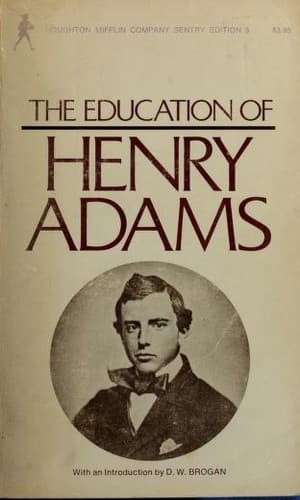
Adams, Henry, 1838-1918; Historians -- United States -- Biography
His friends sometimes took pity on him, and came to share a
meal or pass a night on their passage south or northwards, but
existence was, on the whole, exceedingly solitary, or seemed so to him.
Of the society favorites who made the life of every dinner-table and of
the halls of Congress--Tom Reed, Bourke Cockran, Edward Wolcott--he
knew not one. Although Calvin Brice was his next neighbor for six
years, entertaining lavishly as no one had ever entertained before in
Washington, Adams never entered his house. W. C. Whitney rivalled
Senator Brice in hospitality, and was besides an old acquaintance of
the reforming era, but Adams saw him as little as he saw his chief,
President Cleveland, or President Harrison or Secretary Bayard or
Blaine or Olney. One has no choice but to go everywhere or nowhere. No
one may pick and choose between houses, or accept hospitality without
returning it. He loved solitude as little as others did; but he was
unfit for social work, and he sank under the surface.
Luckily for such helpless animals as solitary men, the world is
not only good-natured but even friendly and generous; it loves to
pardon if pardon is not demanded as a right. Adams's social offences
were many, and no one was more sensitive to it than himself; but a few
houses always remained which he could enter without being asked, and
quit without being noticed. One was John Hay's; another was Cabot
Lodge's; a third led to an intimacy which had the singular effect of
educating him in knowledge of the very class of American politician who
had done most to block his intended path in life. Senator Cameron of
Pennsylvania had married in 1880 a young niece of Senator John Sherman
of Ohio, thus making an alliance of dynastic importance in politics,
and in society a reign of sixteen years, during which Mrs. Cameron and
Mrs. Lodge led a career, without precedent and without succession, as
the dispensers of sunshine over Washington. Both of them had been kind
to Adams, and a dozen years of this intimacy had made him one of their
habitual household, as he was of Hay's. In a small society, such ties
between houses become political and social force. Without intention or
consciousness, they fix one's status in the world. Whatever one's
preferences in politics might be, one's house was bound to the
Republican interest when sandwiched between Senator Cameron, John Hay,
and Cabot Lodge, with Theodore Roosevelt equally at home in them all,
and Cecil Spring-Rice to unite them by impartial variety. The relation
was daily, and the alliance undisturbed by power or patronage, since
Mr. Harrison, in those respects, showed little more taste than Mr.
Cleveland for the society and interests of this particular band of
followers, whose relations with the White House were sometimes comic,
but never intimate.
Public-domain text, read in full here on John Shaqi.
Reviews
Reviews
No reviews yet
Be the first to share your thoughts on this work.
Elsewhere in the archive
Join the Discussion
Join the discussion
Sign in to leave a comment or review.
Sign InorCreate an account