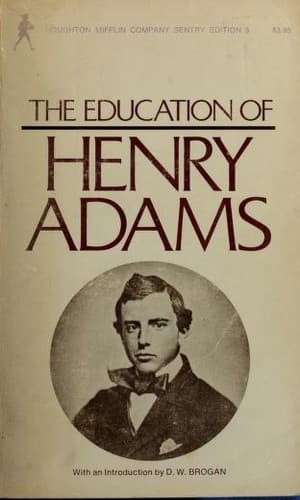
Adams, Henry, 1838-1918; Historians -- United States -- Biography
Adams had taken no interest in the matter, and knew nothing
about it, except as a very tedious hobby of his friend Dana Horton; but
inevitably, from the moment he was forced to choose sides, he was sure
to choose silver. Every political idea and personal prejudice he ever
dallied with held him to the silver standard, and made a barrier
between him and gold. He knew well enough all that was to be said for
the gold standard as economy, but he had never in his life taken
politics for a pursuit of economy. One might have a political or an
economical policy; one could not have both at the same time. This was
heresy in the English school, but it had always been law in the
American. Equally he knew all that was to be said on the moral side of
the question, and he admitted that his interests were, as Boston
maintained, wholly on the side of gold; but, had they been ten times as
great as they were, he could not have helped his bankers or croupiers
to load the dice and pack the cards to make sure his winning the
stakes. At least he was bound to profess disapproval--or thought he
was. From early childhood his moral principles had struggled blindly
with his interests, but he was certain of one law that ruled all
others--masses of men invariably follow interests in deciding morals.
Morality is a private and costly luxury. The morality of the silver or
gold standards was to be decided by popular vote, and the popular vote
would be decided by interests; but on which side lay the larger
interest? To him the interest was political; he thought it probably his
last chance of standing up for his eighteenth-century principles,
strict construction, limited powers, George Washington, John Adams, and
the rest. He had, in a half-hearted way, struggled all his life against
State Street, banks, capitalism altogether, as he knew it in old
England or new England, and he was fated to make his last resistance
behind the silver standard.
For him this result was clear, and if he erred, he erred in
company with nine men out of ten in Washington, for there was little
difference on the merits. Adams was sure to learn backwards, but the
case seemed entirely different with Cameron, a typical Pennsylvanian, a
practical politician, whom all the reformers, including all the
Adamses, had abused for a lifetime for subservience to moneyed
interests and political jobbery. He was sure to go with the banks and
corporations which had made and sustained him. On the contrary, he
stood out obstinately as the leading champion of silver in the East.
The reformers, represented by the Evening Post and Godkin, whose
personal interests lay with the gold standard, at once assumed that
Senator Cameron had a personal interest in silver, and denounced his
corruption as hotly as though he had been convicted of taking a bribe.
Public-domain text, read in full here on John Shaqi.
Reviews
Reviews
No reviews yet
Be the first to share your thoughts on this work.
Elsewhere in the archive
Join the Discussion
Join the discussion
Sign in to leave a comment or review.
Sign InorCreate an account